Overshove vs Poker Bankroll Tracker
Poker Bankroll Tracker is one of the longest-running results trackers: iOS, Android and web, with a multi-variant hand replayer, odds and ICM calculators, player notes and a proper variance output. It is a strong, mature incumbent. It is also less free than it looks: the Basic tier is ad-supported, and variance, CSV export and multiple bankrolls all sit behind Pro. Overshove is younger and narrower, a review-first tool for live cash. Here is the honest split.

Overshove or Poker Bankroll Tracker: what is the real difference?
Poker Bankroll Tracker and Overshove overlap on results and diverge on what happens next. Poker Bankroll Tracker is one of the longest-running trackers in the category, on iOS, Android and web, with a multi-variant hand replayer, odds and ICM calculators, player notes and a proper variance output, per its own site and public App Store listing checked in July 2026. Read its free tier carefully, though: the Basic tier is ad-supported, and variance, CSV export and multiple bankrolls all sit behind the paid Pro tier, which means the exit itself is a paid feature.
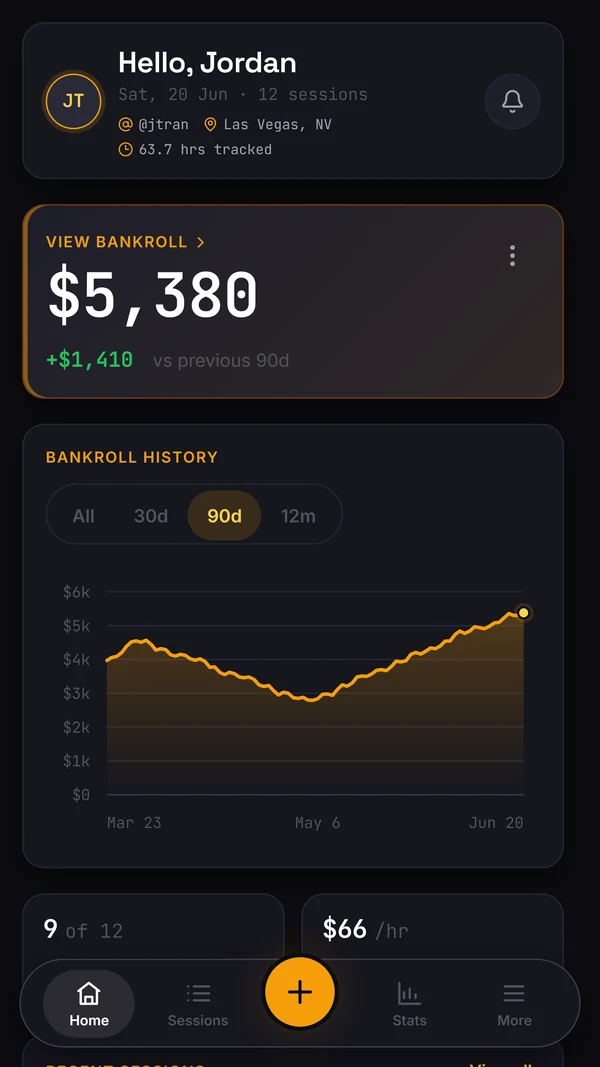
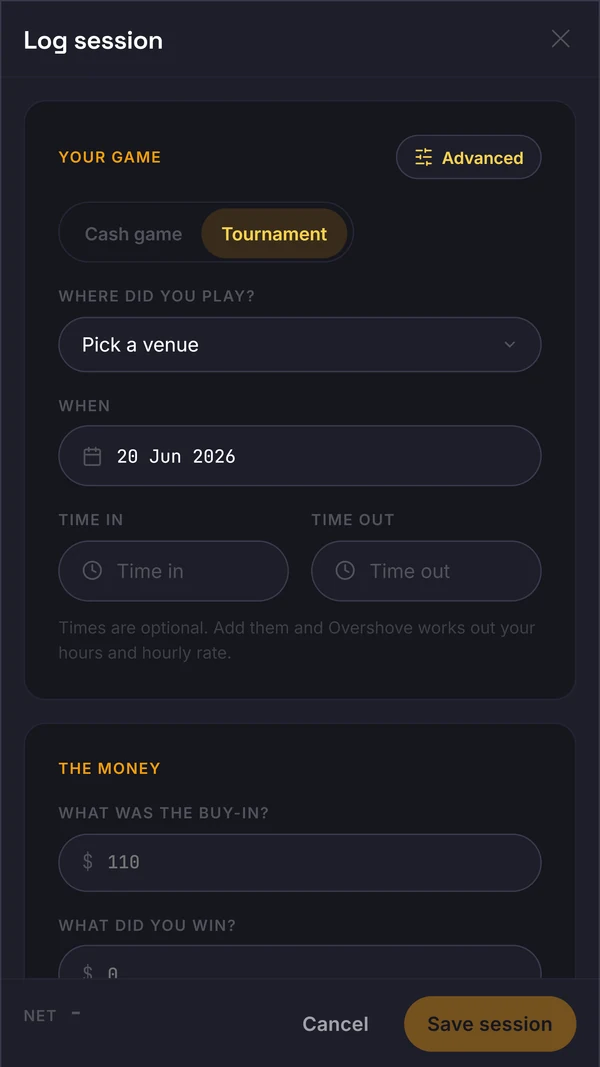
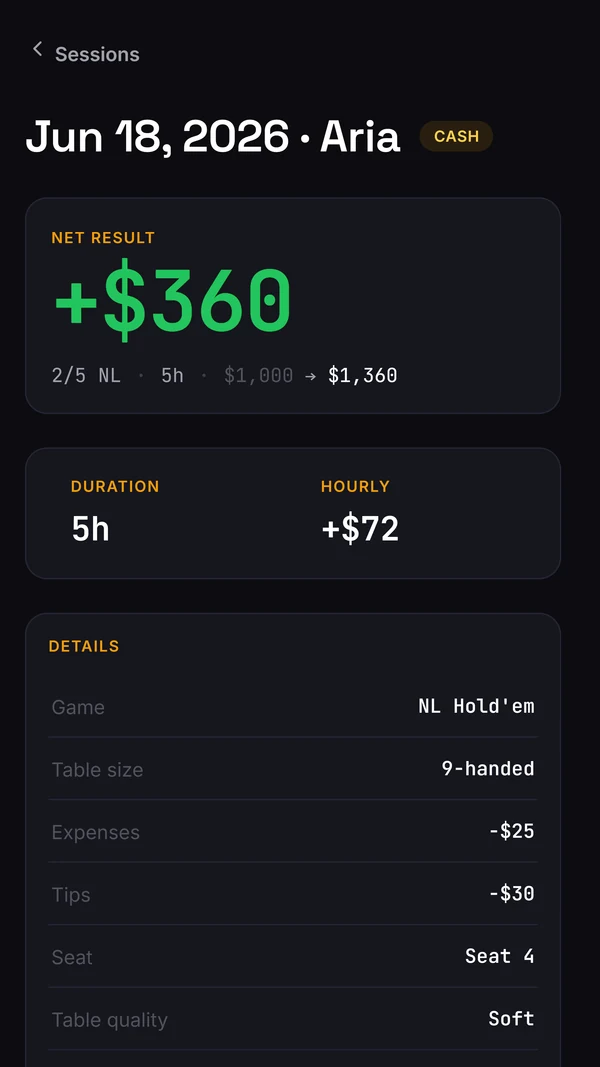
Overshove is younger and narrower, built around the live-cash review loop: the cost-aware hourly, bankroll view and CSV export in the free core; variance interpretation and leak tagging are in development. If you want a mature all-rounder with calculators and a replayer today, the incumbent wins.
A genuinely mature all-rounder
Credit first, because Poker Bankroll Tracker has earned it over years of releases. The hand replayer covers Hold'em, Omaha and 5-Card Omaha, including bomb pots, double boards, straddles and run-it-twice. The calculator stack is real: odds for Hold'em and Omaha, ICM and chip-chop for final-table deals, a payout calculator. It supports more than 40 currencies, live and online play, cash and tournaments, and player notes on the people you face. Its App Store tagline, All-in-one Poker Tracker, is a fair description.
The variance side is also genuine. Its manual documents expected value in BB per 100, standard deviation and risk-of-ruin output, which puts it ahead of most of the category on the maths that matters. Its manual describes dealer tips as in-chip expenses, travel and hotel as costs, with a toggle for hourly with or without them. Check that input convention when reconciling a sample: a breakdown of a stack-paid payment is different from an additional expense deduction. On those rows Overshove is matching a capable incumbent, not beating it, and the table above says so.

The free tier, read carefully
The catch is where the features live. Poker Bankroll Tracker's own Lifetime Pro page lists variance calculation, CSV export, session tagging, multiple simultaneous bankrolls, the advanced replayer and calculator options, and its API as Pro features. The free Basic tier is ad-supported; the company's advertiser page, which exists to sell that ad inventory, says free users see an ad roughly every two hours. If your Pro subscription lapses, the FAQ says your account reverts to a single bankroll.
None of that is a scandal; software costs money to run. But it changes the comparison most players think they are making. The store listing reads like everything is included, while the company's own pricing page gates the headline analytics. At our July 2026 check, Pro was $29.99 a year on the App Store (the site's FAQ separately quotes EUR 24.99) and Lifetime Pro was $229 on the App Store against $199.99 on the site. The two sources disagree, so check the price you are actually offered.
Overshove's answer for contrast: the core tracker is free with no ads, including session logging, the true hourly, the bankroll graph and CSV export. After useful value, the only paid offer is a limited Founder place: one GBP 79 payment for 730 days with no automatic renewal.
Risk of ruin vs a confidence band, worked through
Poker Bankroll Tracker offers documented variance output, while Overshove's in-app variance interpretation is in development. Poker Bankroll Tracker's documented output centres on standard deviation and risk of ruin: given your win rate, spread and bankroll, how likely are you to go broke. A future Overshove confidence read would start with the sample: given your actual sample, what does your hourly really prove.
Concretely: a 1/3 player, £3 big blind, logs 400 hours at an observed 6 BB/hr. With a standard deviation of 100 BB/100 and roughly 27 hands an hour live, the per-hour deviation is about 52 BB. The standard error over 400 hours is 52 divided by the square root of 400, about 2.6 BB/hr, so the 95% band runs from roughly 0.9 to 11.1 BB/hr. That sample says: probably a winner, with the true rate anywhere from marginal to excellent. Risk of ruin takes the same inputs and answers a different question: with, say, a 3,000 BB roll, how safe is the climb.
You want both numbers at different moments. The band is the honest reality check mid-downswing, when it is hardest to tell running bad from playing bad. Risk of ruin is the shot-taking and bankroll-sizing tool. Poker Bankroll Tracker puts this behind Pro; Overshove's in-app variance read is in development; the free on-site variance calculator can model the same question now.
The exit cost is the real difference
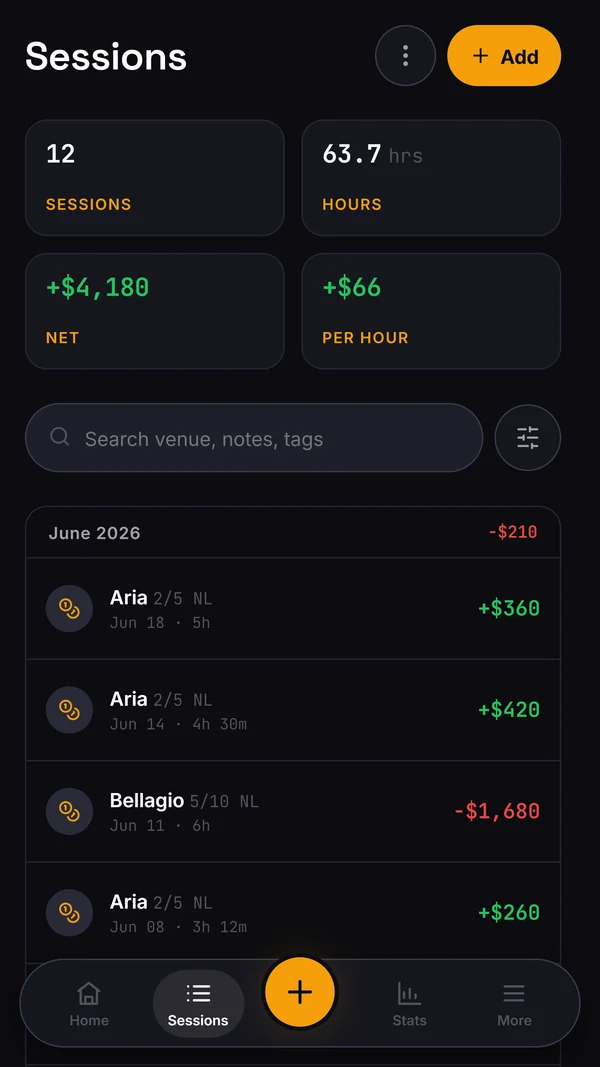
Here is the row that matters more than any feature: CSV import is free in Poker Bankroll Tracker, CSV export is Pro. Getting data in costs nothing; getting your own history out is a paid action. If you ever switch tools, and serious players switch tools every few years, you either hold a Pro subscription at export time or you re-key your history by hand.
That is not unusual in the category, but it is worth naming, because the sample is the asset. Three years of sessions is what makes your win rate and your variance read mean anything. Overshove's position: CSV export in the free core; import controls are visible but have not been checked for full-history fidelity. Whatever you think of the rest of this page, check the export policy of any tracker before you give it years of data.
Migration, or running both
A migration needs a small-file test before any full-history move. Poker Bankroll Tracker imports CSV on the free tier, and Overshove shows session spreadsheet import controls, but mapping and full-history reconciliation need testing; the only asymmetry is that leaving Poker Bankroll Tracker requires Pro for the export step.
Running both is coherent for a mixed player: Poker Bankroll Tracker's calculators, replayer and online support are strengths Overshove does not copy, while Overshove provides live-cash sessions, a bankroll view and CSV export. Its deeper review loop is in development. The free web calculators on this site (variance, hourly, downswing) also work without an account if the calculator stack is all you are missing. A four-week parallel run can use Overshove's free core and settles the question with your own data.
Who should not switch
Stay put if you already own Lifetime Pro and the workflow fits: the paywall argument disappears once you have paid it, and the app is mature, actively updated and broad. Stay if the replayer and calculators are load-bearing in your study, if you need polished native mobile apps today, or if online play is a big share of your volume, since Overshove is live-first with online hand-history import still on the roadmap.
And the standing honesty about Overshove: live web app in phone and desktop browsers, no HUD, no solver, no in-hand advice, no profit promise. It is a session and bankroll tracker for live cash, with deeper study in development. If Poker Bankroll Tracker's breadth is what you use, breadth is a fine reason to stay.

Sources
Product facts checked against first-party pages on 5 August 2026.
- Poker Bankroll Tracker, official product FAQ
Poker Bankroll Tracker features and prices here are summarised from pokerbankrolltracker.net (including its manual, FAQ and Lifetime Pro pages) and its public App Store listing, checked July 2026. Its own pages quote slightly different prices in places, so confirm current pricing and tier gating before deciding. Overshove is live on Google Play for Android and at app.overshove.com in phone and desktop browsers; no iOS or Windows app is available. It is a session tracker, not a HUD, solver or GTO trainer.
Is Poker Bankroll Tracker free?
There is a free Basic tier, but it is ad-supported (an ad roughly every two hours, per the company's own advertiser page) and its site lists variance, CSV export, session tagging and multiple bankrolls as Pro features. Pro was $29.99 a year and Lifetime Pro $199.99 to $229 at our July 2026 check, with the site and App Store quoting different lifetime prices.
Will I lose my history switching to Overshove?
No, but note the order of operations: CSV export from Poker Bankroll Tracker is a Pro feature, so export while you hold Pro. Overshove has a session spreadsheet import control, but test a small file and reconcile totals before relying on a full migration.
Does Poker Bankroll Tracker show variance?
Yes, and properly: its manual documents EV in BB/100, standard deviation and risk of ruin. Its own pricing page lists variance calculation as Pro-only, so budget for the subscription if that is the feature you want it for.
Does Overshove have a hand replayer or calculators?
No by design. The current core focuses on session records rather than full hand replay, and it ships no in-app odds or ICM tools. The free web calculators on this site cover variance, hourly and downswing maths without an account.
How can I use Overshove on my phone or desktop?
The Android app is live on Google Play. iPhone and desktop users can use the web app at app.overshove.com.