Built for serious live cash players
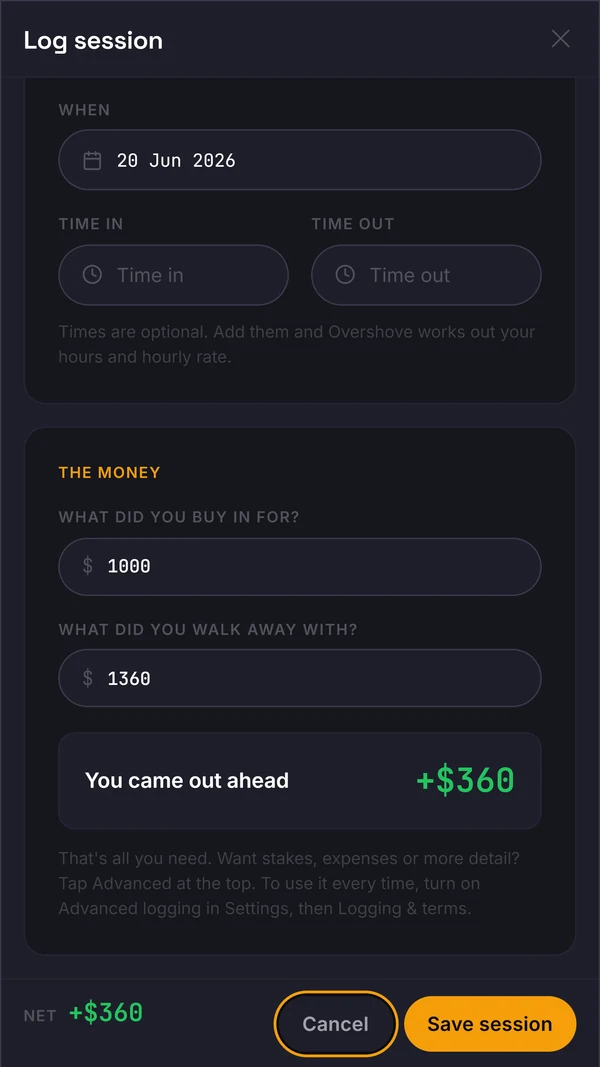
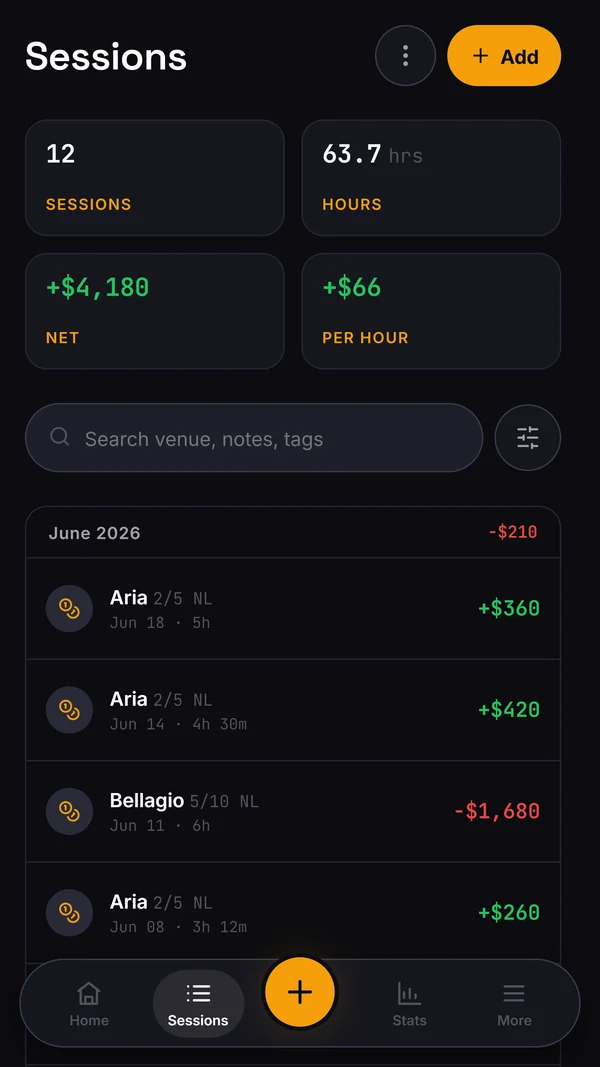
If you play live cash and want a reliable record, Overshove lets you log sessions and review your results by stake and venue in its web app. Its study and variance tools are still being built.

The live-cash reality
Live cash gives you no automatic hand history. A session spreadsheet can be imported, but hands dealt at the table do not arrive automatically. The practical problem is familiar: players often cannot tell running bad from playing bad, and cash-outs minus all buy-ins already reflect pot rake and tips or fees paid from the stack. Additional expenses and decision context need separate records.
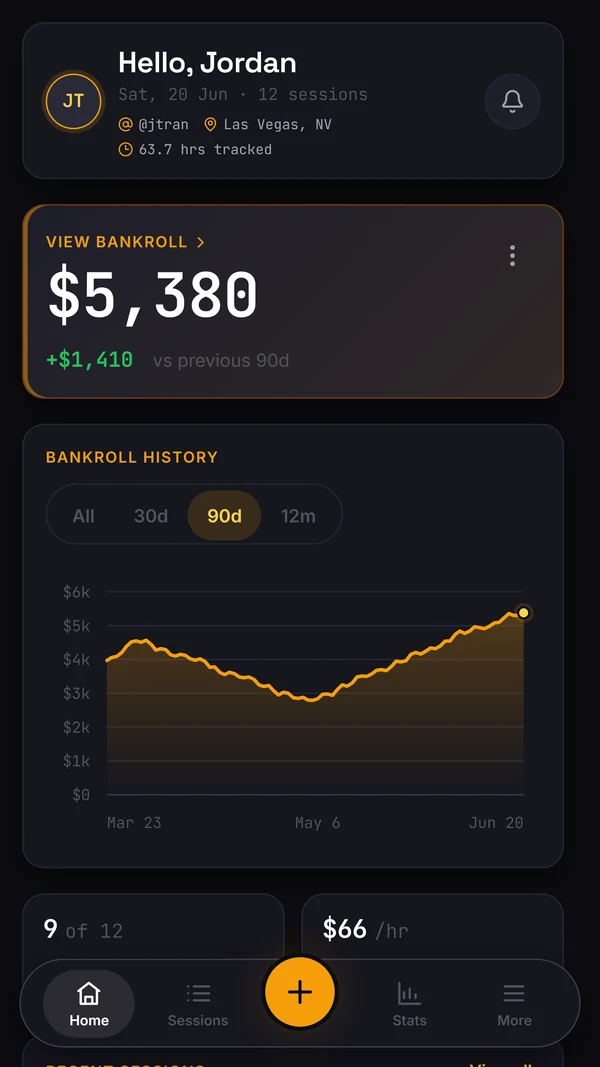
Overshove currently gives you a web session log, a sessions list and a stats view. Recording stake, venue, time and result consistently makes the later review possible. Player reads and variance intelligence appear in the app as upcoming modules; the stats screen should not be mistaken for a proof of your underlying win rate.
A week on the grind
For example, a player logs a Tuesday 2/5 session, then records its duration and cash-out when it ends. On Thursday the same player logs another room. By Sunday, the sessions list contains both records and the stats view can show the combined result and time played. This is an illustrative workflow, not a claim about a customer's data.
For hand review, keep notes in your existing method for now. Overshove's dedicated Study, Player reads and Variance intelligence modules are marked Soon in the live app. A future confidence band should also be treated as an estimate based on assumptions, not a verdict about skill.
What 40 hours actually earned
Take a synthetic month: 40 table hours at £2/£5, with cash-outs minus all buy-ins of +£1,800. That is £45 per table hour, or 9 BB/hr. Assume £240 of tips was paid from the stack: it is already included and must not be deducted again. A further £160 of travel and food was paid separately and is not included in the ledger. After those additional costs, profit is £1,640, or £41 per table hour and 8.2 BB/hr.
Keep cost breakdowns for review, but deduct each payment only once. Door-to-door hourly uses table plus travel time; extra time changes that denominator, not cash profit. The example does not establish which costs the current app calculates automatically or whether it prevents duplicate deductions.
For sample context, 40 hours at an assumed 28 hands per hour is about 1,120 hands. That hand rate is also synthetic. One month cannot establish a long-term win rate.
Variance, quantified on your sample
Here is a model, not a reading produced by the current app. Suppose a player logs 300 hours at 2/5 and observes 5 BB/hr. At an assumed 28 hands an hour, that is about 8,400 hands and 18 BB/100. If the assumed standard deviation is 100 BB/100, the rough 95% interval for that estimate extends about 21 BB/100 either side. It crosses zero. The hand rate and standard deviation are illustrative assumptions; live players rarely know their exact hand count.
The practical lesson is to keep logging during downswings and review decisions separately from short-run results. Overshove's dedicated variance module is marked Soon, so this calculation is educational rather than a description of a chart currently in the product.
- →Log live cash sessions in the web app
- →Review time and results in Stats
- →Export session records to CSV
- →Study and variance modules are upcoming