Overshove
Core tracker free

Know if the edge
is real.

Log every live session in seconds. Track the true hourly. Find out whether you are running bad, or just bad.

Start with the free coreNo card neededExport anytime
+15.2%
Bankroll
+£4,180· 90 days
90 days
True hourly
+£34/hr
+8.3 BB/hr over 612 hours, after rake and tips.
61 / 100
Readiness today
61
Play with care
Sleep below your average
Win rate, confirmed
6.4BB/hr · true
95% confidence band of +4.3 to +12.3, clear of zero.
Your loop
Next study action
Study value betting
Key hands waiting
1 hand to review
River
A♠K♠ vs 99
Bricked the flush, paid off a set. Should have checked back the turn.
Leak: turn barrel

What does Overshove do for a live cash player?

Overshove is a live poker session tracker and bankroll manager built for cash players who want to know whether their edge is real. It exists because the usual live record, buy-in and cash-out, cannot answer that question. Overshove keeps the entry at the table small, venue, stake, buy-in, cash-out and time, so sessions still get logged after bad nights, then adds the fields a ledger leaves out: rake context, dealer tips and travel, which turn a gross result into a true hourly. Around that record it puts a variance read, standard deviation and a confidence band, so a losing stretch can be judged against the model rather than the mood, and a review loop of marked hands, tagged leaks, a private notebook of player reads and one study action before the next session. Overshove is not a HUD, not a solver and gives no in-hand advice. The core tracker is free during beta, and the full history exports to CSV at any time.

Log at the tableReview on desktopOne synced accountExports to CSV, no lock-inNo HUD or solverNo win-rate promises
A worked example

A number means nothing
without the read.

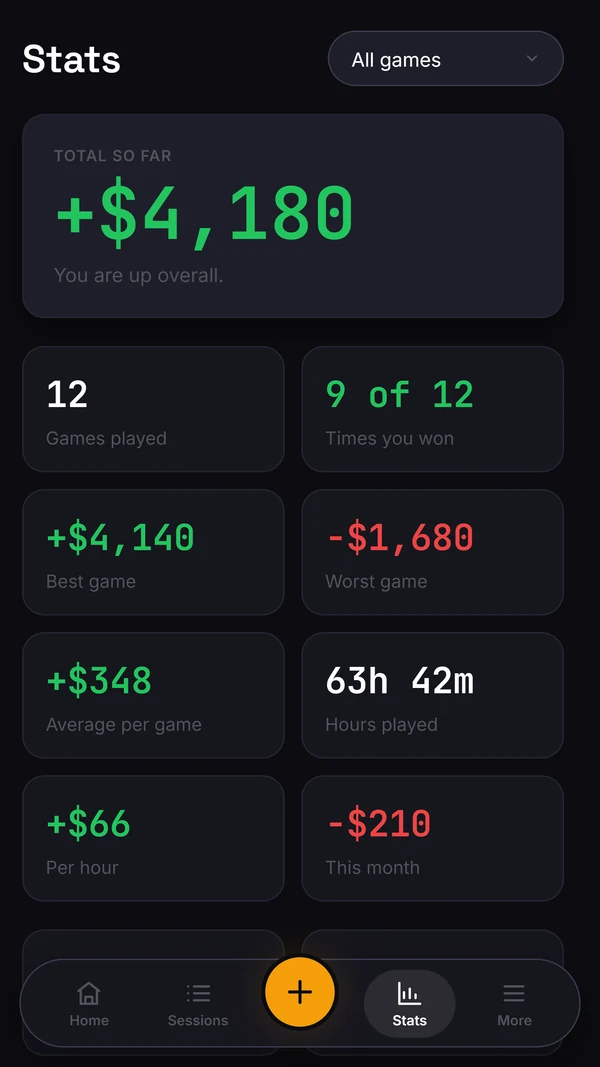
One example account, 612 logged hours. Overshove turns the raw totals into a read you can actually trust, not a profit screenshot.

6.4
Win rate · BB/hr
95% band clear of zero
+£34
True hourly · /hr
after rake, tips & travel
612
Hours logged
across 142 sessions
≈1.5
Downswing · buy-ins
normal at this win rate
The four agonies of live cash

Every live player knows these. Most tools ignore them.

01, Variance

Am I running bad,
or am I just bad?

The question behind every downswing. Live players never hit the sample to know, so they panic, quit early, and jump stakes on tilt.

More than 1 in 10 solid winning players will question their entire existence after 100k hands, purely due to variance.

Variance intelligence reads your real sample
Win rate confirmed positive

Across 612 hours your true win rate looks like +8.3 BB/hr (£34/hr). The whole 95% confidence band sits above zero, a real, measured edge.

+4.3 BB/hr95% confidence+12.3 BB/hr
+8.3
True win rate · BB/hr
≈1.5
Downswing · buy-ins
02, Memory

You remember three hands
out of three hundred.

Live poker has no auto hand history. You reconstruct from memory, feel awkward logging at the table, or never review at all.

I might come back from a session and only remember three or four hands out of hundreds., Bart Hanson

Mark the hand, keep the note, review later
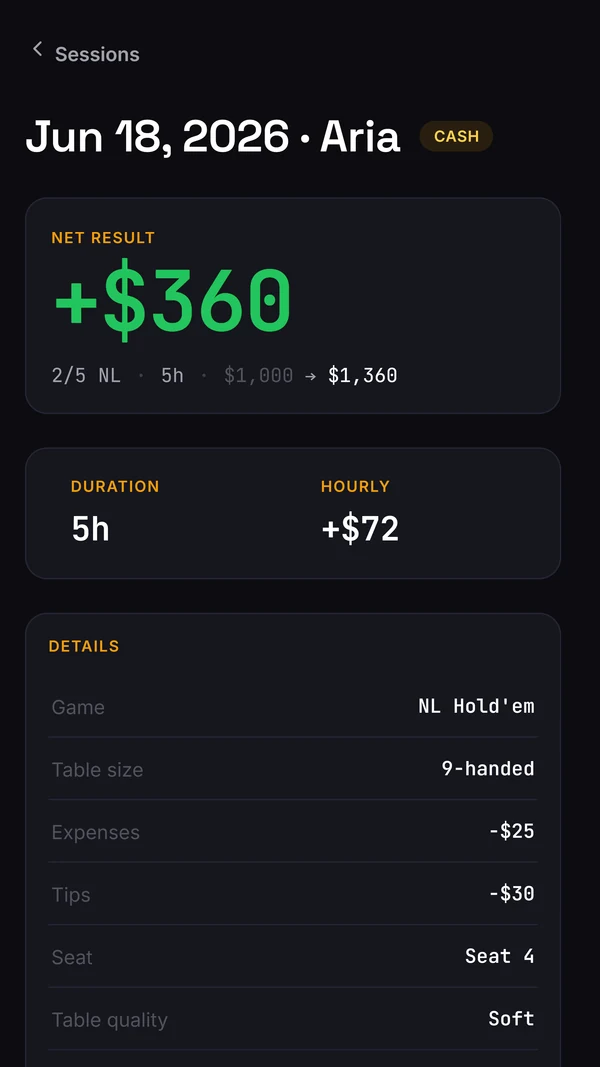
Aria · 2/5 NL+£360
A♠K♠ vs 9♥9♦River
Bricked the flush, paid off a set. Should have checked back the turn.
Leak: turn barrel
Q♣Q♦ vs stationTurn
Thin value got there, bet 3 streets, called by top pair.
Good line
Table noteSeat 7
Never folds an overpair. Stop bluffing the calling station.
03, Friction

Logging shouldn't
be a chore.

Too many fields before the timer starts, so players abandon the app and fall back to Excel, which quietly corrupts every stat.

The most sophisticated results tracker is zero good to you if you don't use it religiously., Lee Jones

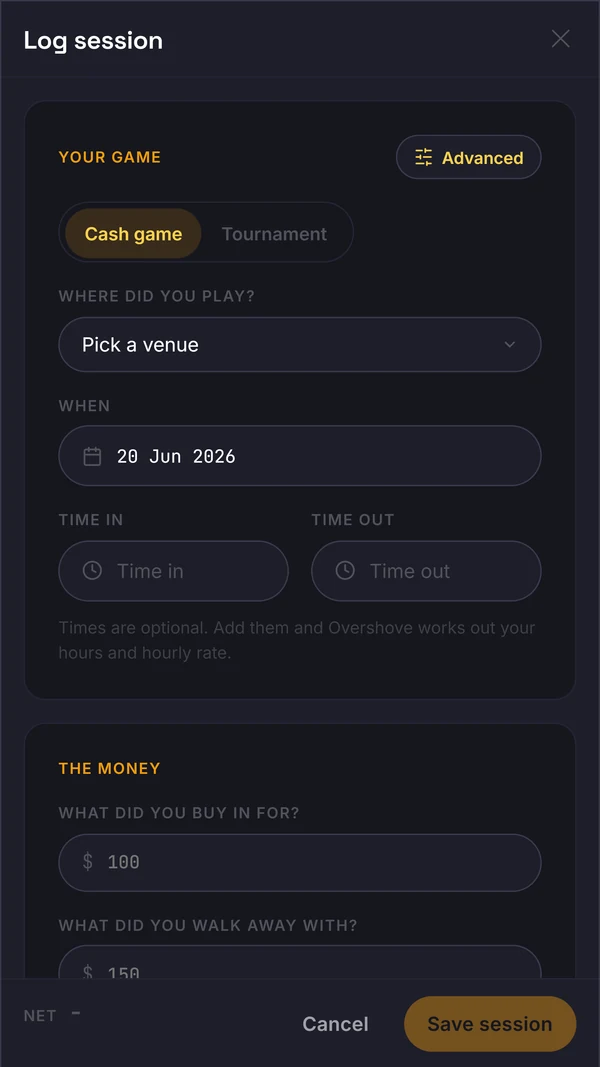
Six fields, then the clock runs
New live session
CashTournament
Venue
Aria
Game
NL Hold'em
Stake
2/5 NL
Table size
9-handed
Buy-in
£ 1,000
Currency
GBP
Privacy
PrivateFriendsPublic
Start session
04, True hourly

Your win-rate
is a fiction.

Rake, tips and travel quietly halve the real hourly. Most trackers only capture buy-in and cash-out. Overshove tracks net, by stake, against a real sample.

A £1/£2 player earning 8 BB/hr before rake nets just 3 after the cap, 62% of their win-rate, gone unnoticed.

See the real hourly, by stake
Breakdown
StakeVenueDay
1/2 NL+£760
2/5 NL+£3,940
5/10 NL−£520
Tournaments+£3,100
£20.4
Gross / hr
£14.8
Net / hr · after rake, tips, travel
See it in action

Log on mobile. Review on desktop.

One account, synced. Capture the session where you play, do the thinking where you study, the same record everywhere.

01
Log
Six fields and the clock runs. Fast enough to do at the table.
02
Review
True hourly, net by stake, with a confidence band on your win rate.
03
Study
Tag the leak, queue one action, run a warm-up before you sit.
Overshove
InstallSynced
3
Home
Sessions
Log
Staking
Study
Players
Friends
Stats
Leaks
Leaderboards
Events
Tools
JT
Jordan Tran
jordan@overshove.gg
JT
Hello, Jordan
Saturday, 20 Jun 2026
CashAll
BankrollView bankroll
£4,180
+£1,410vs previous 90d
All30d90d12m
By stake
1/2 NL
+£760
2/5 NL
+£3,940
5/10 NL
−£520
Sessions
142 sessions · 612 hours tracked
CashTourn.All
£BB
Trips
Manage
Bin·1
Select
Add
Sessions
12
Hours
63.7
Net
+£4,740
Per hour
+£74
Search venue, notes, tags
June 2026+£290
Home
Sessions
Stats
More
Log at the tableReview on desktopSynced, exportable
Your sample

tells you whether a downswing is normal variance or a leak worth studying.

Overshove puts the confidence range beside your results so a short run does not become a story.

The whole toolkit

Everything a serious live player tracks.

Four agonies, one workflow, plus the deeper tools that keep you logging, studying and growing.

Honest comparison

Built around review.

NeedOld appsHUD toolsOvershove
Fast live session loggingCommonNot the jobYes
True hourly after rake & tipsRareNoYes
Variance and confidence readNoRareYes
Study log tied to sessionsRareSeparateYes
Notebook of player tellsPatchyOnline-focusedYes
In-game HUD or solverNoYesNo by design

A workflow comparison, not a claim against every competitor. Overshove does not replace HUDs, solvers, or online databases.

Switching

Your history
comes with you.

Coming from a spreadsheet or another tracker? Bring the whole thing across as a CSV, bankroll, sessions, stakes, and pick up where you left off. Export it all back out whenever you want.

Import from CSV in minutes
Keep your full bankroll history
Export everything, anytime, no lock-in
Import sessions
bankroll_2026.csv · 142 rows
Mapped
DateSession date
VenueVenue
ProfitNet result
HoursDuration
Confirm import · 142 sessions
Pricing

Everything core is free. Forever.

Start with the free core. After a useful first session or review, the only paid offer is a limited Founder place.

Basic
A clean, free tracker. Log sessions, see core stats and manage your bankroll.
Freeforever
Free for everyone, no card, ever.
Unlimited live cash sessions
True hourly after rake & tips
Bankroll graph and core stats
CSV import and export
20 places
Founder
The deeper review tools after you have experienced useful value.
GBP 79730 days
One-time payment. No automatic renewal.
Everything in Basic
Variance intelligence & confidence band
Readiness, drills & trips
Player reads notebook
Founder terms
Try it safely
The free core comes first. Founder is optional and shown only after a useful review.
14 daysfull refund
No separate monthly tiers during recovery.
The free core stays available
GBP 79 for 730 days
No automatic renewal
Full refund within 14 days

The core tracker stays free. Founder is one GBP 79 payment for 730 days, with no automatic renewal, limited to 20 places and a 14-day full refund. See the full terms.

The private beta

Start with the free core.

Log a session and see a useful review before any Founder offer appears. Here is what you get today, and what is landing next.

In the beta today
Core session logging and review, free
Web and Windows, fully synced
CSV import and export
A direct line to shape the roadmap
On the roadmap
Online hand-history importPlanned
iOS & Android appsIn progress
More tracker importsPlanned
Deeper staking & tax toolsPlanned
Your data

Your results are yours.

Money and results are private by default. We do not sell them, share them, or turn them into a HUD.

Private by default
Every session is yours alone, until you choose to share it.
Export anytime
Your full history out as CSV whenever you want. No lock-in.
Never sold
Your data is never sold or handed to third parties.
No HUD, no overlay
Nothing runs at the table. Built for review, away from the hand.
Questions

The short answers.

A poker tracking and study system for serious live cash players: fast session logging, true-hourly stats, variance intelligence, a study log, a notebook of player tells, readiness, staking and imports.

Log. Study.
Overshove.

Start free today, no card needed. Everything core is free, forever.

Answer guide

What Overshove actually tells a live cash player.

Overshove is built around one practical question: is your live poker edge real enough to base decisions on? A normal tracker can say whether you bought in for less than you cashed out. That is useful, but it is only the ledger. Live cash needs more context because the game charges you in places the ledger hides: rake that comes out of pots, dealer tips, travel time, parking, long sessions where your decision quality drops, and samples that stay noisy for longer than your gut wants to admit.

The fast log comes first

A session log only works if you keep using it after bad nights. The minimum entry needs to be fast enough for the table: venue, stake, buy-in, cash-out and time. If the routine takes too long, the sessions that go missing are usually the losing ones, and the remaining sample flatters you. Overshove keeps the entry small at the table, then lets you add the cleaner detail after the session when you are no longer trying to follow the action.

The hourly has to be true

Buy-in minus cash-out is the headline. The true hourly is the decision number. It should account for time in the seat, rake model, tips, travel and the room you chose. Those details tell you whether a room is actually better, whether a stake jump is sensible, and whether a small win rate is being eaten by the cost of sitting in the game. Without those fields, a bankroll graph can look honest while still hiding the cause.

Variance needs a number

A live sample can be directionally useful and still far from proven. Overshove frames the result with standard deviation, confidence and downswing context so a losing stretch is not treated as proof the game is broken, and a heater is not treated as proof you are ready for the next stake. The point is not to remove emotion completely. It is to put one measured number between the feeling and the decision.

The review loop is the product

Overshove is not a HUD and it is not a solver. It does not watch a live hand, does not tell you what to do during a decision, and does not pretend that software can manufacture an edge. The useful work happens after the session. You mark the hands that mattered, tag the leak if one shows up, write the read on the player who keeps taking the same line, and queue one study action before the next session. That is how the log becomes more than bookkeeping.

The same loop protects the bankroll. When the confidence band is wide, the site should say so. When a downswing is inside expectation, the answer is not panic, it is review and discipline. When the sample points to a repeat leak, the answer is a study block, not another heroic table change. The system is deliberately blunt because live cash already gives players enough ways to rationalise a bad decision.

For spreadsheet players, the switch point is simple. If the file is only a rough net and you play a few sessions a month, it may be enough. If you are making stake, schedule, coaching or bankroll decisions from that file, the fields and variance read need to be first-class. Overshove is for that second moment: when the number is going to change what you do next.

Common questions before you log the first session

Is this for live cash only?

Live cash comes first because it has the dirtiest tracking problem: manual logging, slow samples, room costs, tips, travel and repeated local player pools. You can still log other poker formats as sessions, but the product decisions are judged against live cash first. If a feature helps a serious live player keep a cleaner sample or make a better review decision, it belongs near the top of the queue.

Why not just use a spreadsheet?

A spreadsheet is enough when volume is low and the only question is whether you are up or down. It starts to break when real decisions depend on it. Most sheets miss travel, tips, rake context, confidence and session discipline. Overshove keeps the ownership benefit through CSV export, but removes the midnight admin that makes bad sessions disappear from the record.

What should I log from day one?

Log every session, not just the ones you feel like recording. Capture stake, venue, buy-in, cash-out, hours and any costs that change the true hourly. Mark the hands that deserve later review, but do not write a novel at the table. After the session, add the note, the player read, the leak tag and one study action. That is enough to start building a sample you can actually trust.

How does it help during a downswing?

It gives the stretch a frame. A downswing can be normal and still painful, or unusual and worth investigating. The difference is not decided by mood. It is decided by bankroll depth, win rate, standard deviation, sample size and whether the hand review shows repeated mistakes. Overshove keeps those pieces together so the response can be calmer: drop down if the bankroll rule says so, study if the leak shows up, and keep logging if the result is still inside the model.

What does private mean?

Your bankroll, notes and reads are yours. If social features or public profile pieces are used, they are opt-in and intentionally coarse. The core product is personal review, not broadcasting exact venue, stake, bankroll or opponent notes. A live cash tracker has to respect the fact that the most useful information is often the information you would never post.

What is free in beta?

The core stays simple and free: session logging, bankroll, true hourly and CSV export should not be a trap door. After useful value, one limited Founder offer adds depth. The sample itself remains portable. If a tracker will not let your data leave, it does not deserve the data in the first place.

What to measure after the first month

After the first month, ignore the urge to declare a final win rate. Live samples are too slow for that. Instead, look for the decisions that are already clear enough to improve. Did you log every session, including the ones you lost? If not, the first leak is tracking discipline. Did one room look good in raw profit but weaker after travel and tips? That is a scheduling decision. Did the late part of long sessions keep giving money back? That is a stop-clock decision. Did the same leak tag appear across multiple marked hands? That is next week's study block.

The bankroll question comes next. A player with a clean first month can see whether the current stake is sized sensibly, whether a shot needs a fixed budget, and whether moving down would protect the sample rather than bruise the ego. The point is not to make poker feel mechanical. It is to stop each decision being made from the emotional temperature of the latest session.

The player-notes question is different. You are not trying to build online-style frequencies on a live regular. You are trying to preserve useful evidence: the river call that was too wide, the limp-call pattern, the timing tell, the player who overfolds after checking twice. A short, decision-shaped note beats a long memory every time, especially when the same person appears again next week.

The study question is the final one: what should change before the next session? A good review produces one action, not twelve. Run a calculator, check a guide, tag a leak, write a note, or set a session-length rule. If the log does not produce a better next session, it is only a prettier ledger. Overshove is built to keep that last step visible.

A month is also enough time to find the first product habit. Some players will open the app only at the end of a session and treat it like a ledger. Others will mark hands during play, add notes after the cash-out, and check the review page the next morning. The second habit is where the value compounds. It turns one night of poker into one cleaner rule, one sharper read, one tagged leak and one better plan for the next seat. That is the reason the site keeps repeating log, review, study and export. The sequence is boring on purpose, because boring systems survive losing weeks better than hype does.

The same first month should also show what Overshove is not trying to be. It is not a public leaderboard for exact bankrolls, not a social feed that turns every session into content, and not a promise that tracking alone makes someone win. The product earns trust when it records the unglamorous parts clearly: costs, mistakes, uncertainty, export, and the next piece of work. If those facts are visible, a player can decide with less drama. If they are hidden, even a beautiful graph is only another way to guess.

That is the simple test for every future feature too. Does it make the record more complete, the decision more honest, or the next study action easier to take? If the answer is yes, it supports the core loop. If the answer is no, it can wait. Serious live poker already creates enough friction; the tracker should remove friction from truth, not add theatre around it.

Start with one honest log tonight. The rest of the system only matters if that first habit survives. Record the session even if it was short, boring, tilted or forgettable. Add the cost fields even if the result already feels obvious. Mark one hand if it deserves review, then stop. A clean first entry is more valuable than a perfect plan you never use. Tomorrow, that entry becomes evidence instead of memory. The sample only gets stronger when ordinary sessions are allowed to count.

A practical playbook for using a live poker tracker

Start with the smallest honest entry. A live poker tracker fails when the log becomes a chore. The first entry only needs the fields that anchor the session: venue, stake, buy-in, cash-out, start time and end time. If you can add game type, seat, table quality, tips and travel without slowing the process, do it. If not, save the session first and complete the detail later. The important point is that every session exists in the record, including the ones you would rather forget.

Do not let the good sessions become the sample. The most common tracking leak is selective memory dressed up as admin delay. A player logs the easy wins, misses the late losses, then looks at a graph that appears calmer than the real bankroll. That is worse than not tracking because the number feels objective. Overshove is built around a fast log because discipline is the first metric. If the ugly session goes in the same night, the sample has a chance to tell the truth.

Separate ledger profit from decision profit. Buy-in minus cash-out is the ledger. The decision number is the true hourly: result after the time and costs that shaped the session. A player can be up in chips and still discover that one room, one commute or one schedule is doing less work than expected. Rake context, dealer tips, parking, fuel and door-to-door time are not details for accountants. They decide whether a game is actually worth playing again.

Review by question, not by mood. A losing session does not automatically prove a leak, and a winning one does not prove a good decision. After a session, ask four questions. Was the table worth sitting in? Did the session end by rule or emotion? Which hand is most worth reviewing? Which one behaviour should change before the next buy-in? Those questions are small enough to answer consistently and specific enough to produce a better next session.

Use variance as a guard rail. Live samples grow slowly. A month of volume can feel huge because the money is real, but in hand-count terms it is still small. The tracker should make that visible. If a downswing is inside the model, the answer is not panic, it is discipline. If a stretch is outside the model and the hand notes show repeated mistakes, the answer is study. Variance does not remove emotion, but it stops one graph from becoming the whole story.

Tag leaks in the language you actually use. The best leak taxonomy is not clever. It is memorable. River overcall, thin value missed, tired call, bad seat, table too tough, turn give-up, bluff timing, stop-loss ignored. A tag that you recognise instantly is better than a formal category that you never apply. After enough sessions, repeated tags become a study plan. The goal is not a perfect library. The goal is to see the same mistake before it costs another buy-in.

Keep player reads private and useful. Live cash is often a repeat-player environment. The same faces, lines and emotional patterns come back. A good note is short, specific and decision-shaped: overfolds after checking twice, pays off river when draws miss, opens too wide after losing, slowplays strong hands out of position. A bad note is a label that feels satisfying but cannot help a decision. Overshove keeps the notebook tied to venues and sessions because reads are only useful when they appear at the right table.

Run a weekly review before adding more features. Once a week, open the sessions, marked hands and leak tags. Choose one pattern. If the issue is technical, study the spot. If the issue is emotional, write a rule. If the issue is table selection, change the schedule. The review should end with one action, not a motivational speech. A tracker earns trust when the next session is cleaner because the previous one left evidence.

Export before you trust any system. Your sample is the asset. A poker tracker can be beautifully designed and still be the wrong home for your data if you cannot leave with the full record. Export early, open the file, check that sessions, costs, notes and dates are readable. Overshove keeps CSV export as a core promise because a player should pay for depth and convenience, not because the exit is blocked.

Judge the first month by habits, not final answers. The first month should prove whether the workflow survives real play. Did you log every session? Did the cost fields stay complete? Did marked hands become study notes? Did one venue, stake or session length stand out? Did a rule prevent at least one bad decision? Those are better early signals than the exact win rate. The win rate will need more hours. The habit tells you whether the hours will be worth reading when they arrive.

Let boring accuracy beat dramatic confidence. Most live poker mistakes around tracking come from wanting certainty too soon. A clean tracker should be comfortable saying that the sample is early, the band is wide, and the next move is to keep logging. That answer can feel less exciting than a big graph or a bold claim, but it is more useful. Serious bankroll decisions deserve boring evidence. Overshove is built to collect it one session at a time.

Choose one main number for each decision. The same session can create several numbers: net profit, hourly, BB per hour, door-to-door hourly, pre-cost hourly, risk of ruin and confidence range. They are not interchangeable. Use bankroll for survival decisions, true hourly for venue and schedule decisions, marked hands for study decisions, and confidence range for whether the sample is strong enough to trust. Mixing those numbers creates arguments instead of answers.

Make table selection visible. Many live players track their technical decisions but barely track the game they chose. That misses one of the biggest levers in live cash. A mediocre decision in a good game can make more money than a perfect decision in a bad one. Use short table notes: passive, splashy, reg-heavy, straddled, short-stacked, deep, tired, too tough, worth waiting, not worth waiting. Over time those notes explain the graph better than the graph explains itself.

Protect the record during downswings. A downswing is when tracking feels least appealing and matters most. Set a rule now: every losing session is logged before sleep, even if the review waits until tomorrow. If the session was emotionally messy, write one neutral note and stop. Do not turn the tracker into punishment. The goal is not to relive every hand while tilted. The goal is to preserve the evidence so tomorrow's calmer version of you has something useful to inspect.

Use stop-loss rules as data, not shame. A stop-loss is not proof you cannot handle the stake. It is a guard rail around decision quality and bankroll depth. Record whether the rule fired, whether you followed it, and what the table looked like when it did. If the same stop-loss fires often in one venue or at one session length, that is information. Maybe the game is too big, maybe the schedule is bad, maybe fatigue is the real opponent. The log should make that visible without drama.

Keep the study queue short. A long list of study tasks feels productive and then gets ignored. After each session, mark the hand or leak that would most improve the next session. One spot is enough. If the same theme keeps returning, it becomes the weekly block. If it disappears, the study worked. This is why Overshove keeps the study loop attached to the session log instead of treating study as a separate notebook that drifts away from the hands that caused it.

Check the export before the habit is expensive. The best time to test data ownership is the first week, not after a thousand hours. Export a small sample, open it, and confirm the record makes sense outside the app. A useful poker tracker should make leaving boring. If leaving is painful, the product is relying on lock-in instead of value. Your bankroll history, player notes and study tags should remain yours even if the tool changes shape later.

Let the tracker stay narrow. A live poker tracker does not need to be a social network, a solver, a public leaderboard and a content machine. The core job is narrower: record the session, protect the bankroll, clarify variance, preserve reads and turn review into one next action. Extra features are only useful when they strengthen that loop. The simplest version that you keep using is better than the impressive version you avoid after a bad night.

Use the same words every time. Consistent labels make review possible. If one session says "tired call", another says "fatigue", and another says "wanted to win it back", the pattern hides in plain sight. Pick the few phrases you will actually remember and reuse them. The point is not tidy admin. It is making the same mistake easy to spot before it becomes part of your identity at the table.

Make improvement visible in the next entry. A good tracking system should show whether the work changed the following sessions. If you studied river calls, did the river overcall tag appear less? If you set a session-length rule, did the late mistakes fall? If you changed venue, did true hourly improve after travel? Progress does not need a heroic breakthrough. It needs the next ordinary session to be a little cleaner than the last one.

Keep bankroll rules outside the session. The worst time to invent a bankroll rule is while the cashier is counting chips. Decide the stake limits, shot budget, move-down point and stop-loss before play starts. Then the session log records whether you followed the rule. That turns bankroll management from a debate into a repeatable system.

Treat missed entries as a finding. If a week has gaps, do not hide them. Note why they happened. Too tired, app too slow, loss too annoying, forgot venue, played unplanned. The reason tells you what to fix next. A tracker that exposes its own usage gaps is doing its job, because the first edge is a complete record.

Start again whenever the log breaks. A missed week is not a reason to abandon the tracker. Mark the gap, restart with the next real session, and keep the sample honest from there. Continuity matters, but recovery matters more.

Review the ordinary sessions too. Break-even nights often show the best habits and the quietest leaks.