The live poker tracker built for review
Live poker has no auto hand history. A live tracker has to make capture instant, make a few marked hands go a long way, and tell you the truth about a sample that is always smaller than it feels. That is what Overshove is built for.
What should a live poker tracker record?
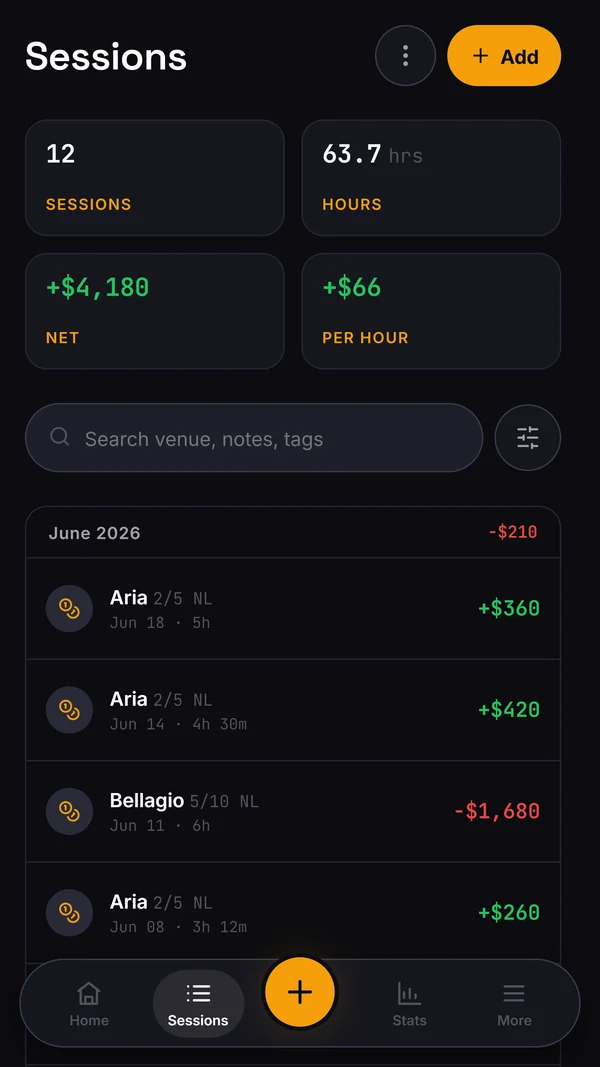
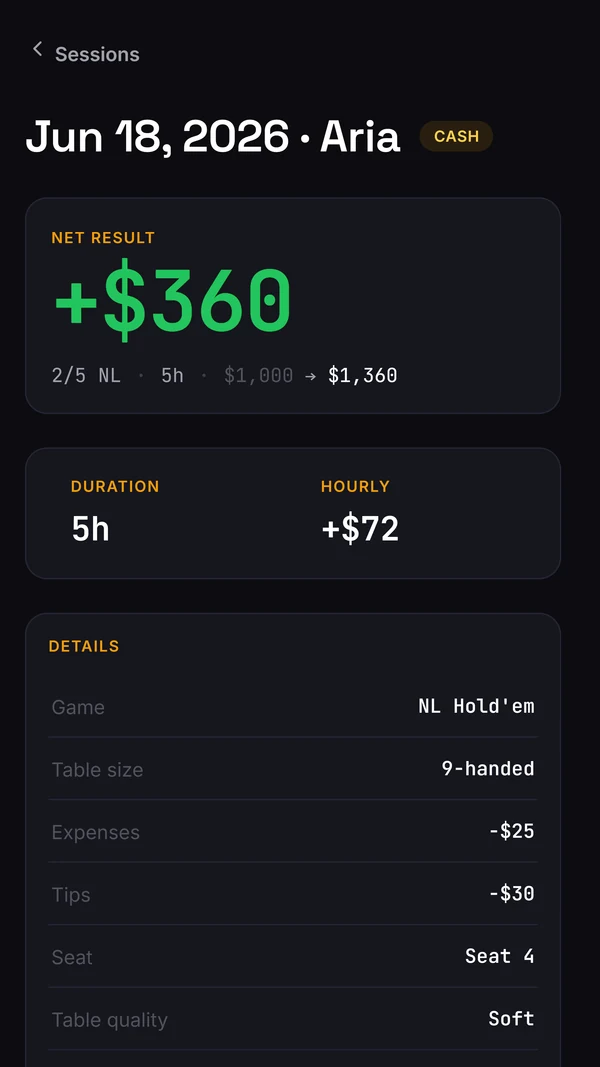
A live poker tracker should record every session accurately enough to calculate net result, hours, hourly rate and bankroll movement, without making table-side entry so slow that sessions go missing. The minimum useful record is the date, venue, game, stake, buy-in, cash-out and time played. Cash-outs minus all buy-ins already include pot rake and stack-paid tips or time charges. Deduct only additional expenses not already included, and label table hours separately from any total trip time.
The tracker should also preserve context you can use later. A short note on game quality, the reason the session ended and one or two marked hands can explain more than another decorative chart. Every summary must trace back to a session you can inspect and correct. Export matters for the same reason: the history is your sample, so you should be able to take it out in a common format.
Overshove is built around that session record. It is a review tool for live players, not a HUD, solver or promise of profit. The web app handles capture on a phone and review on a larger screen, with the same account history available across supported surfaces.
How is live tracking different from online tracking?
Online poker software can read hand histories created by the poker client. Live poker has no automatic hand file. Unless a player records the session, the only durable facts may be a card-room receipt, a banking transaction and a memory that changes by morning. That makes the capture habit part of the measurement system.
A live tracker should therefore ask for less at the table and create space for more after it. Start the clock, record the game and money, then return during the cool-down for notes and marked hands. Trying to reconstruct every action while playing is distracting and unreliable. Capturing nothing until the next day is equally risky, especially after a tiring loss.
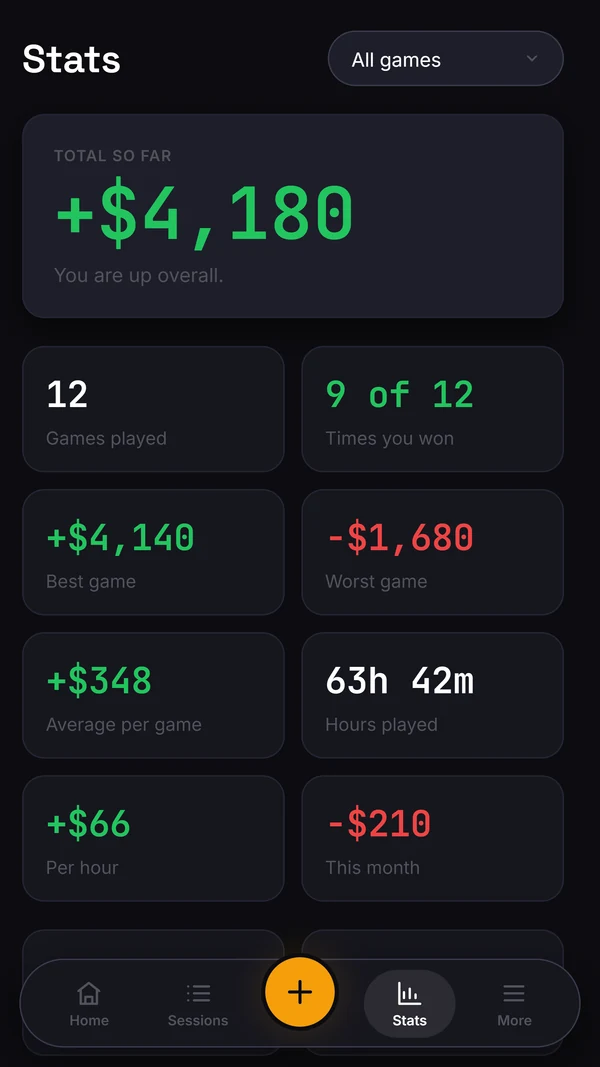
The smaller live sample changes how the results should be read. Twenty online tables can produce thousands of hands quickly. A live player may see only 25 to 30 hands an hour. A hundred hours can feel like a long stretch of life while remaining a modest statistical sample. A responsible tracker helps you keep the record complete and keeps uncertainty visible instead of treating a short run as a final win rate.

Which fields protect the sample?
Completeness matters more than novelty. Date, venue, stake, format, buy-in, cash-out and duration create the base ledger. A consistent stake field lets you express results in big blinds as well as cash. A separate cost field prevents fuel, parking, tips and entry charges from disappearing into an hourly that looks better than the money actually earned.
The next useful fields explain behaviour. Record whether the game was short-handed or full, whether you changed tables, how strong the line-up felt and why you stopped. Keep those labels simple enough to use consistently. A free-text essay after every session becomes another chore and usually collapses during a downswing.
Missing losses are the most damaging error. A player who logs every clean win but skips the ugly late session has not merely lost one row. The missing row raises the apparent net, hourly and win rate at the same time. The best tracker is the one you still use when the graph is painful, because that is when sample integrity is under the most pressure.
The true hourly, not the gross
Cash-outs minus all buy-ins already reflect pot rake and tips or fees paid from the stack. Deduct only additional expenses not already included, then divide by clearly labelled table hours or total trip hours. Cost breakdowns support review without another deduction.
How should you calculate a true live poker hourly?
Start with cash-outs minus all buy-ins. Pot rake and tips or fees paid from the stack are already included. Subtract only additional costs outside that result and divide by hours on a stated basis. In a synthetic example, GBP 500 cash-out after GBP 300 of buy-ins gives GBP 200, or GBP 33.33 over six table hours. Separately paid travel of GBP 18 leaves GBP 182, or GBP 30.33 per table hour. Do not deduct stack-paid tips again. Adding travel time to an overall trip hourly changes the denominator, not the GBP 182 profit.
The distinction compounds. Across 100 sessions, small omitted costs can remove thousands from the apparent annual result. Do not invent historical costs to make an old sample look complete. Leave unknown fields blank, state the date when cost tracking began and compare like with like.
Hourly rate also needs context. A strong figure from 30 hours is not equal to the same figure from 1,000 hours. Split by stake, game and venue only when each slice has enough observations to be worth reading. A tracker can calculate any division, but the player still has to decide whether the sample supports the conclusion.
How do marked hands become useful study?
A live player cannot import a complete hand history, so marked hands must be selective. Save the spots that created uncertainty: a river call you nearly made, a turn size that changed the range, a bluff that depended on a player read or a decision made while tired. Record the important stack sizes and action while they are fresh, without trying to narrate every street at the table.
During review, attach a practical tag such as river overcall, three-bet pot out of position, thin value or fatigue. One tag on one hand is an observation. The same tag across several sessions is a study candidate. That is more useful than choosing study subjects from whatever video happened to appear in a feed.
End the review with one behaviour for the next session. The action might be to check a range, write a fold rule for a familiar player type or leave when a fatigue marker appears. The log does not improve a win rate by itself. It creates a trail from real play to deliberate practice.
How should you read a live win rate?
Treat the displayed win rate as an estimate with uncertainty, not an identity. Live samples grow slowly, game conditions change and the hands are not independent laboratory trials. A long upswing can flatter a weak process, while a disciplined player can lose for a substantial stretch.
Check the record in layers. First confirm that every session is present and the money reconciles. Then look at hours, stake and venue splits. Only after that should you ask whether the observed rate is stable enough to guide a move. A confidence range or variance simulation can show how wide the plausible outcomes remain, but it cannot prove that the underlying play is strong.
Use results alongside behaviour evidence. Repeated late finishes, missing notes, rising costs or the same marked-hand tag may justify a change before the win-rate estimate settles. Conversely, one losing month does not automatically require a technical overhaul. A complete tracker helps separate a financial observation from a diagnosis.
Who should use a live poker tracker?
A tracker is most useful when poker decisions depend on more than memory. That includes a regular cash player comparing rooms or stakes, a tournament player keeping buy-ins and returns in order, a recreational player setting a firm entertainment budget and anyone replacing a spreadsheet that no longer gets updated consistently.
It is less useful for a person seeking automatic online hand analysis, a real-time HUD or solver recommendations. Overshove does not provide those jobs. It also cannot correct a selective logging habit if the player refuses to enter losses. The tool removes friction and organises the review; responsibility for a complete record stays with the player.
Before moving a history, export a clean copy of the current data. Check dates, currencies, stake labels and whether costs are already included in net results. Import a small sample first and compare the totals. The right migration preserves the old record without pretending missing fields were measured.
- →Log sessions, then review their results and hours.
- →Keep bankroll history alongside the session record.
- →Use the free calculators to explore sample size and bankroll risk.
- →Study, player reads and variance intelligence are in development.
Questions
Is it a HUD?
No. There is no in-game overlay, a HUD is impossible live. Overshove is built for review away from the table.
Does it work on my phone?
Yes. The web app works on any phone; log at the table and review on desktop, all synced.
Can I import old data?
The web app has a session spreadsheet import and CSV export. Try a small import and reconcile session count, hours and results before relying on a migrated history.