Live vs online poker tracking
Online poker hands itself to a tracker: every hand has an exact history, imported automatically. Live poker has none of that. A live-first tracker is built around that gap, not bolted onto an online tool.

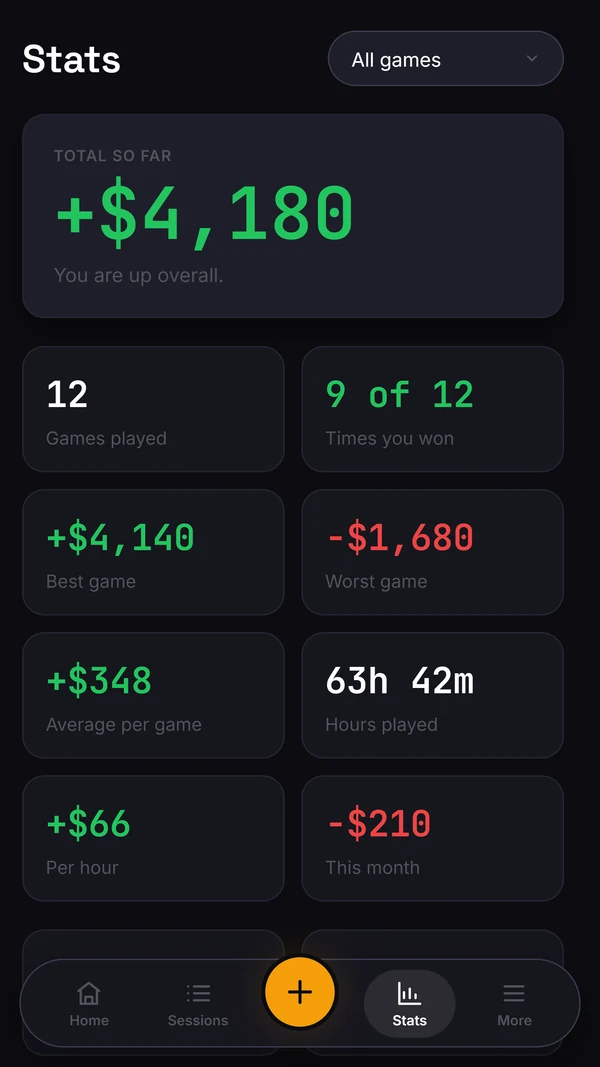
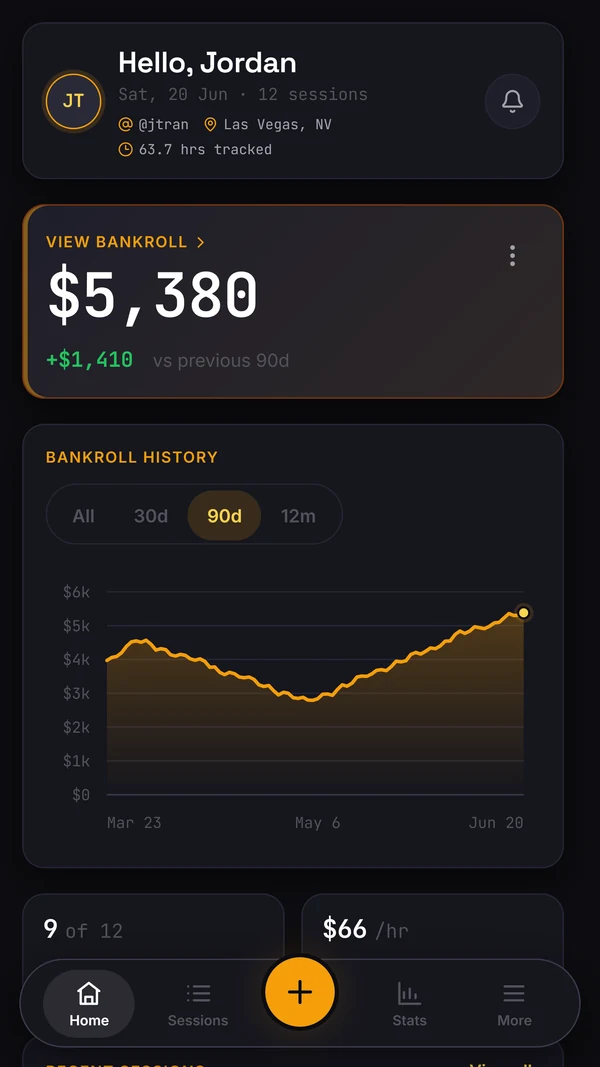
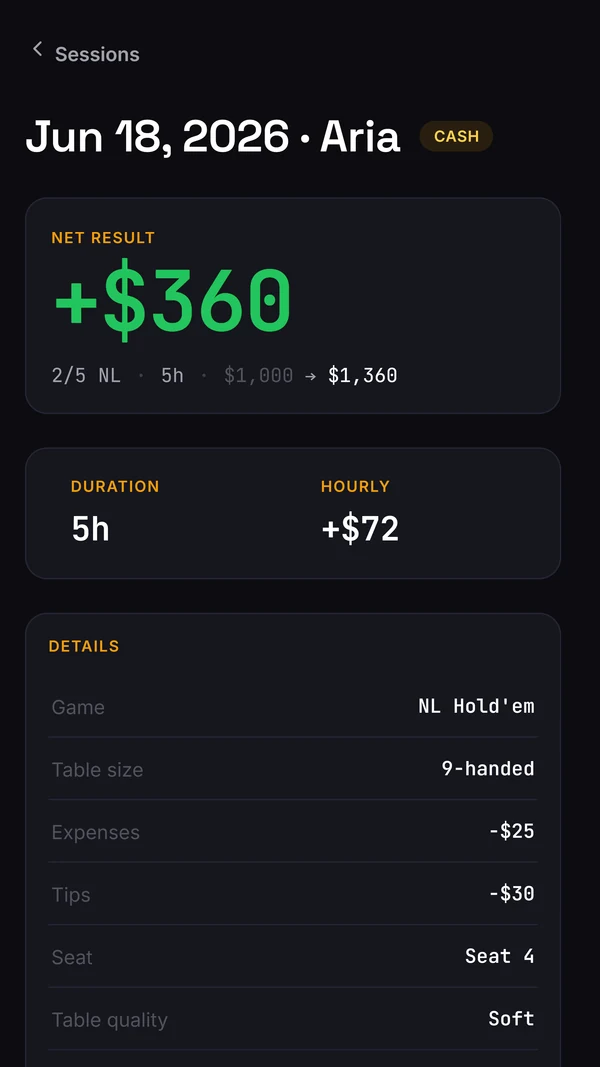
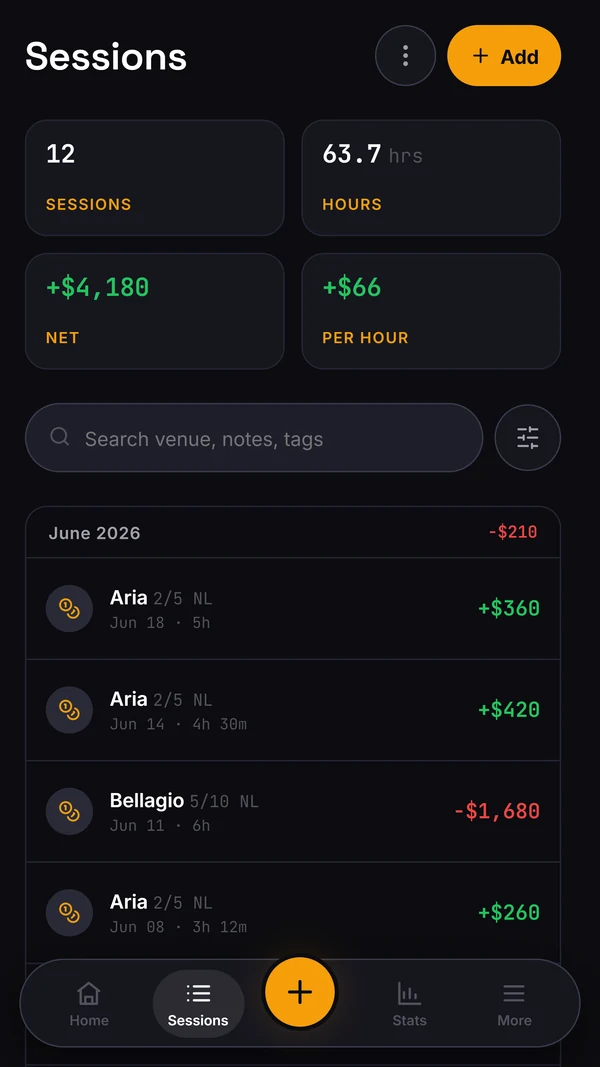
How is live poker tracking different from online?
Live and online poker tracking differ at the source of the data, and everything else follows from that. Online poker writes an exact hand history for every hand, so a tracker imports thousands of hands automatically and can report stats per 100 hands with reasonable precision. Live poker produces no hand histories at all. The record has to be entered by a person, usually tired, often after the session, so a live-first tracker is designed around capture speed and sample honesty rather than around import volume.
The unit changes too: live tracking works in sessions and hours instead of hands, which is why live win rates are quoted per hour. Live review can also benefit from rake/tip breakdowns and additional travel expenses. Stack-paid costs are already in results; check the particular product rather than assuming an online-first tracker cannot record expenses. And the sample grows far more slowly, at roughly a few dozen hands an hour, so confidence bands stay wide for much longer and matter a great deal more.
Where online-first trackers genuinely win
Credit first. Online-first trackers solved data capture completely. Every hand you play online arrives as a text file with exact stacks, positions, actions and results, and the tracker ingests all of it without you touching anything. That gives you BB/100 to two decimal places, positional win rates by seat, and a database covering every opponent you have ever faced. Over a large online sample those numbers sit close to ground truth, and the category has earned its reputation for it.
Live players get none of that by default. Many record results in a spreadsheet or a simple buy-in and cash-out log, but still cannot tell whether they are running bad or playing bad. The gap is not effort. It is that the tools which made online data effortless were never built for a game with no data feed.
There is a second genuine win for the category: leak-finding at population scale. Filter a million hands for single raised pots, out of position, on paired boards, and the tracker shows your EV loss by line. That style of study only works because the sample is enormous and every hand is machine-readable. It is real edge, and no live tool can replicate it.

Where the category breaks for live cash
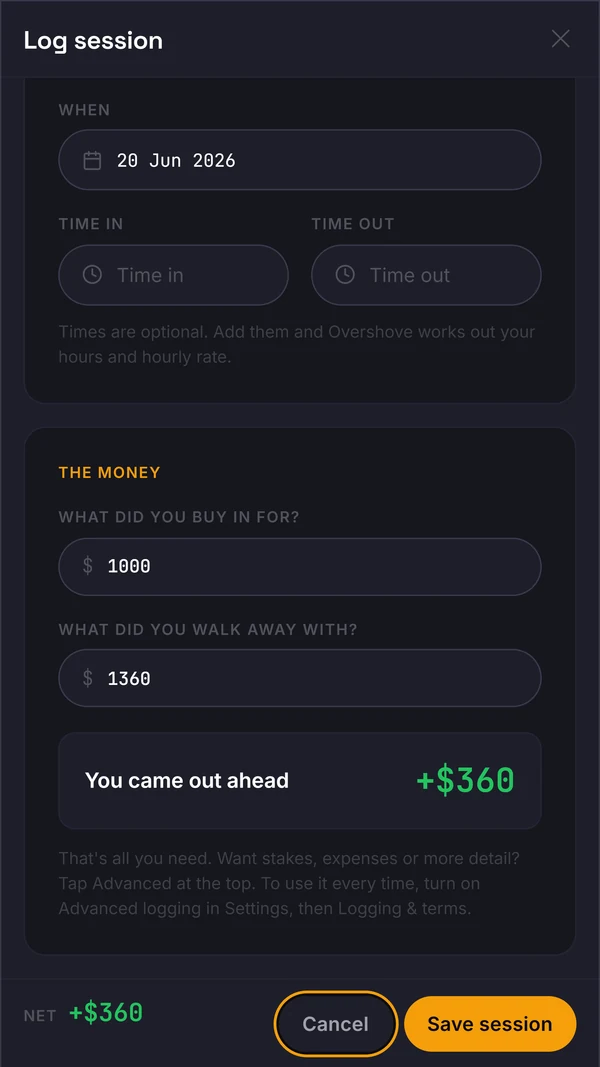
A live game has no automatic hand-history feed, so check what manual session entry the particular tracker supports. It may be sufficient for a result, or it may need additional fields for your review.
Separate the accounting jobs. Pot rake and stack-paid tips already affect cash-out results. Additional travel costs or out-of-stack charges may need expense fields, while rake structure and tipping breakdowns help explain differences between sessions. Travel time belongs in a separately defined overall hourly. None of this establishes that every online-first tool lacks those inputs.
Then there is the pool. Live, you face the same thirty regs every week at the same venue. A notebook of reads, who never bluffs the river, who stacks off with one pair, is one of the most durable edges in live cash, and an opponent database keyed to screen names has no equivalent for it. Capture speed matters too: if logging takes more than a few seconds between hands, it does not happen. Logging is most likely to stop during a downswing, precisely when the record matters most.
The sample-size gap, worked through
Put numbers on the data gap. A live full ring game deals roughly 25 to 30 hands per hour; call it 27. An online grinder on four tables at about 80 hands each sees around 320 an hour. To reach a 50,000 hand sample, the online player needs about 156 hours (50,000 divided by 320). The live player needs about 1,852 hours (50,000 divided by 27). At 25 table hours a week, that is just over 6 weeks online against 74 weeks live, roughly a year and five months.
Now run the confidence arithmetic on a realistic live sample. Take a standard deviation of 100 BB/100, mid-range for live full ring. That is 10 BB per hand, so per hour it is 10 times the square root of 27, about 52 BB/hr. After 500 logged hours your standard error is 52 divided by the square root of 500, about 2.3 BB/hr, so a 95% interval is plus or minus 4.6 BB/hr. An observed 7 BB/hr win rate over 500 hours means your true rate sits somewhere between roughly 2.4 and 11.6 BB/hr.
That is the design brief for a live tracker. BB/100 to two decimals is meaningless at live volumes, so the tool has to record sessions accurately and show a cost-aware hourly. Confidence bands and a fuller study workflow remain in development. Overshove currently delivers the session and bankroll record; variance intelligence and a fuller review loop are in development.
Migrating, or running both
If you play both formats, run both tools and keep the units separate. Your online database stays the system of record for online volume and BB/100. Live sessions go into a live-first tracker in BB/hr, with rake, tips and travel captured at the table. Do not average the two win rates into one number: different rake structures, different pools, effectively different games.
Migration starts with an export from your current tool and a small-file import test in Overshove. Overshove shows a session spreadsheet import control, but its mapping and full-history fidelity have not been verified, which matters because the confidence arithmetic above only tightens with every logged hour you keep. The core tracker is free, runs in phone and desktop browsers, and exports back to CSV any time, so there is no lock-in in either direction.
The combined study loop looks like this: log the live session in seconds, mark the two or three hands that felt wrong, then review them later against your solver output and tag the leak. Overshove is not a solver and not a HUD. It currently holds the session log and bankroll view; variance interpretation and a fuller study record are in development, and it sits fine alongside whatever GTO tooling you already run.
Who should not switch
If 90% or more of your volume is online, do not switch. An online-first database is the right tool for that job and nothing live-first will match its hand-level depth. Add a live tracker only when live hours become a meaningful share of your results, and even then run it alongside, not instead.
If you play live once a month at small stakes and just want a rough net, a spreadsheet is honestly enough. We say the same on our spreadsheet comparison page. The case for a purpose-built live tracker grows with volume and with how much you care about your cost-aware hourly and bankroll record, none of which a casual sample can support anyway.
If what you actually want is in-game stats on live opponents, no tool can give you that, and you should be suspicious of any that claims otherwise. There is no live data feed, and Overshove gives no in-hand advice by design. And if you know you will not log at all, be honest about it now: a live tracker cuts capture to seconds, but it cannot log a session you never enter. The habit is the product. The tool just makes the habit cheap.
Sources
Product facts checked against first-party pages on 5 August 2026.
- PokerTracker, first-party online tracker capabilities
- PokerBase, first-party live session and bankroll capabilities
A workflow comparison against a category of tool, not a claim against any specific product. Overshove does not replace HUDs, solvers or online databases.
Can one tool do both well?
Each is built around a different data reality. Overshove is live-first; online hand-history import is on the roadmap.
Why BB/hr and not BB/100 live?
You cannot reliably count live hands, so a per-hour rate is the practical standard.
How many live hours before my win rate means anything?
Treat anything under 500 hours as provisional. At a standard deviation near 100 BB/100 and about 27 hands per hour, even 500 logged hours leaves a 95% interval of roughly plus or minus 4.6 BB/hr around your observed rate. It tightens slowly with volume, so log everything and treat the point number as provisional. Overshove's in-app confidence read is in development.
Can I import my online hand histories into Overshove?
Not yet. Overshove imports session logs as CSV, and online hand-history import is on the roadmap. For now the practical split is your online database for online hands and Overshove for live sessions.
Is manual live logging accurate enough to trust?
Session-level entry is verifiable: buy-in, cash-out, hours and tips can be checked against your bankroll the same night. The real risk is skipped sessions, not typos. Selective logging biases a sample faster than any fat-finger error, which is why capture speed is the feature that matters.