Best free poker tracker (2026)
Plenty of trackers say free and mean trial. A genuinely free tracker gives you the core, logging, true hourly, bankroll, export, with no clock. Here is what to check before you commit your sample to one.

What is the best free poker tracker in 2026?
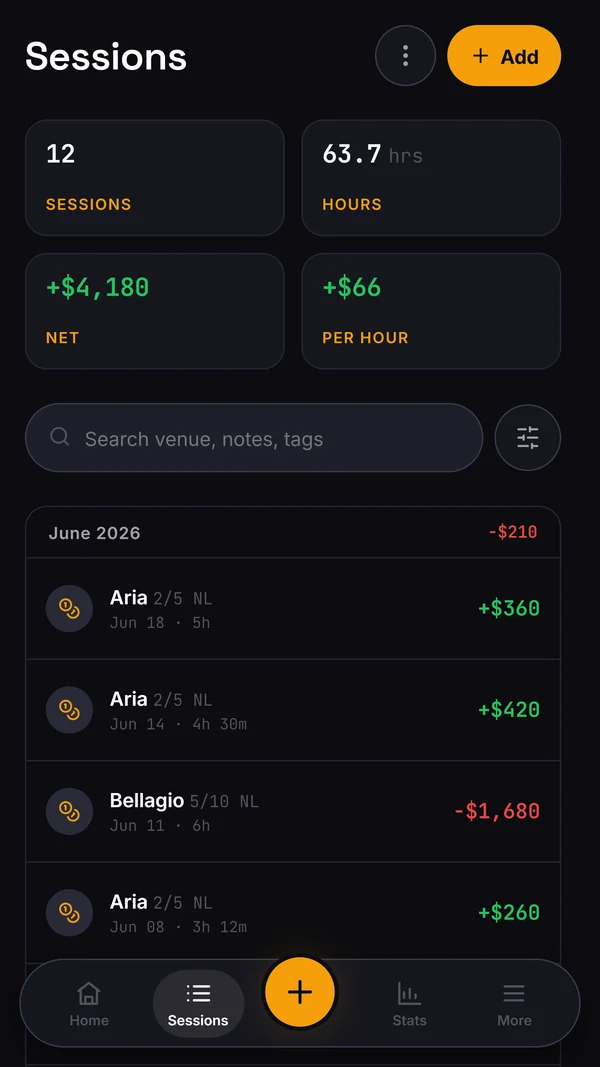
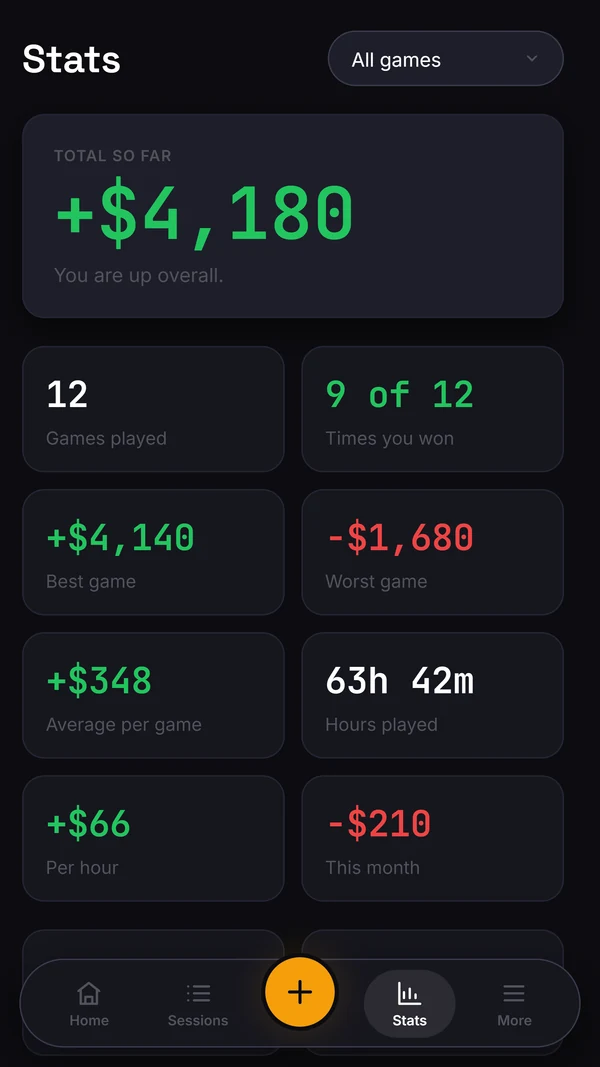
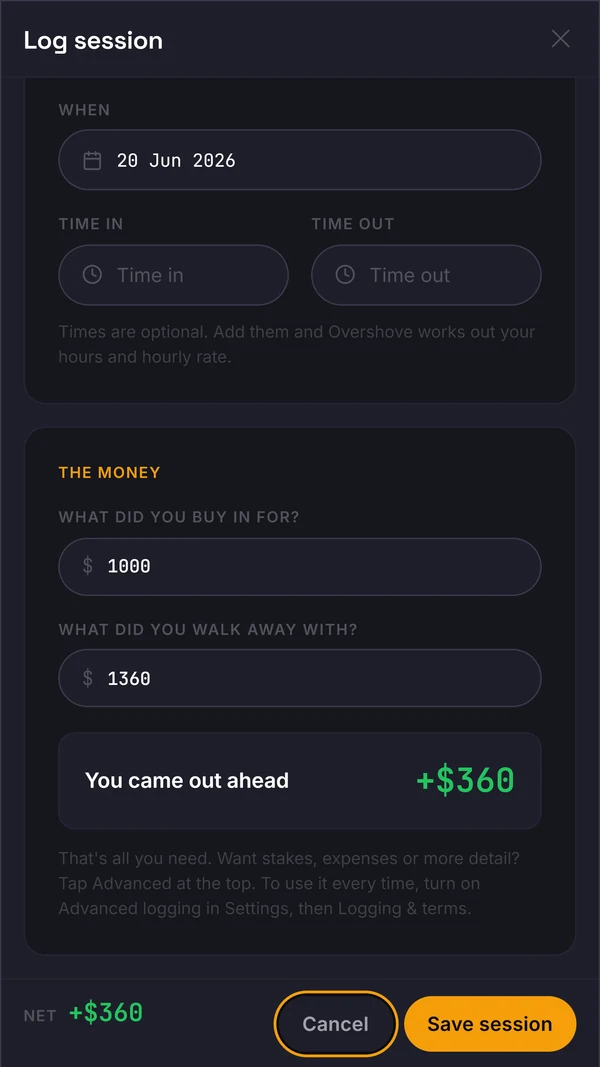
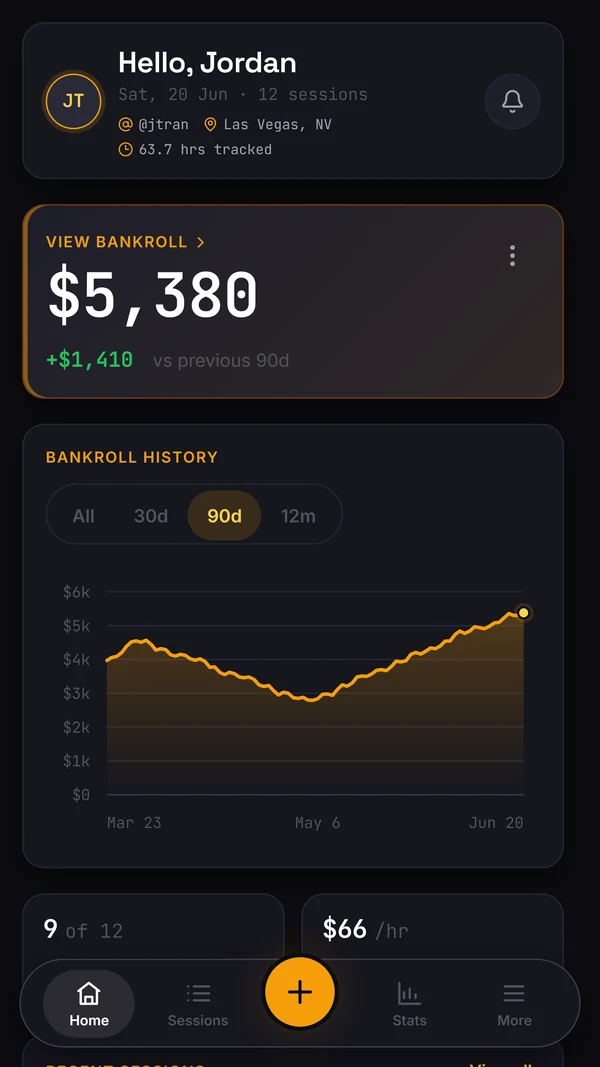
The best free poker tracker is the one that lets you keep the whole sample, export it, and still gives you the numbers that matter before you pay anything. For live cash, that means fast session logging, bankroll tracking, the true hourly after costs, and a way to understand variance rather than staring at a graph. Overshove's free web core covers the session record, bankroll and cost-aware hourly today; its in-app variance and study workflow is still in development.
A spreadsheet is still the best free option if you play low volume and are willing to build the missing fields yourself. If you need staking, social posting, GTO charts or a hand database, another specialist tool may fit better even if the free tier is narrower. The honest answer depends on the job, but the non-negotiables are simple: no fake trial, no export hostage, and no sample cap that arrives just when your history becomes useful.
Best free poker tracker checklist
Use this checklist before trusting any free poker tracker with a real sample. First, the tracker must save unlimited sessions or give a clear, generous limit that will not arrive before the sample becomes useful. A cap at twenty or fifty sessions is not a free tracker for a serious player; it is a trial. Second, it must let you export the full history as CSV. If export is paywalled, the free tier is borrowing your data rather than serving you.
Third, check the money fields. A free poker tracker that stores only buy-in and cash-out is a ledger. For live cash, the useful number is an hourly on an explicit cost and time basis. Cash-outs minus all buy-ins already include pot rake and stack-paid tips or fees. Check which additional costs are outside that result and whether the tool can record them without a duplicate deduction. Fourth, check review. A serious free tracker should let you mark hands, tag leaks or at least attach structured notes that connect the session to the next study action. Without that, the graph can look good while the game stands still.
Finally, test the habit. Log three mock sessions on your phone, then imagine doing the same thing after a losing night. If the flow feels heavy in a calm test, it will fail under tilt. The best free poker tracker is not the longest feature list. It is the one that keeps the honest sample alive.

What free should not mean
Free should not mean a hidden countdown. Some products let you start, gather the early history, then lock the pieces you need most once you are committed. A trial can still be useful, but it should be called a trial. The problem is the fake free tier that appears generous until the export button, variance view, cost fields or usable history length moves behind a paywall.
Free also should not mean data lock-in. Poker data is personal and slow to rebuild. A year of live sessions carries venues, stakes, game quality, travel, costs, notes, hands and emotional context. Losing that sample is not like losing a theme setting. It changes future decisions. Any tracker that cannot hand the full history back in a clean file should be treated as temporary, no matter how polished the dashboard looks.
The clean model is simple. The core log stays free, the data stays portable, and the optional Founder offer deepens the review rather than holding the record hostage. A player should pay because a deeper tool is useful, not because leaving would destroy the sample.
The criteria that matter, before any names
Many live players already record something, often in a spreadsheet or a basic buy-in and cash-out log. The result can still leave them unable to tell whether they are running bad or playing bad. Free is not the scarce thing here. A tool that turns a log into an answer is.
So before any names, pin down what free should mean. A genuinely free tracker gives you unlimited session logging, hours, additional-expense inputs and optional rake/tip breakdowns, a bankroll graph, and export with no paywall. What it must not be is a trial with a countdown, a session cap that arrives just as your sample gets useful, or an export button that unlocks only when you subscribe. If the free tier cannot hold your whole history and let you leave with it, it is marketing, not a tier.
Then judge the shortlist on five criteria, the same five you would apply to a paid tool. Logging speed: can you log a session in seconds, at the table, on a phone? Hourly basis: does it deduct only additional costs and state whether hours mean table or trip time? Variance: does it tell you whether your win rate means anything at your sample size? Study path: can you mark hands and tag leaks, or is it a ledger? Ownership: does your data come out as cleanly as it went in? Everything below hangs off those five.
The comparison: eight options, honestly
The table below covers the trackers that come up when live players go looking for a free option, plus the two defaults: the spreadsheet and Overshove itself. Named-tool cells reflect facts from each product's official site or public store listing as checked in June 2026. On pricing, the verified positions were narrow: the spreadsheet is free, PokerLog lists a free tier with a paid Prime upgrade, and Overshove's core tracker is free. The other apps' current pricing was not verified for this page, so check their store listings before committing a sample. The longer per-product breakdowns live in the head-to-head comparisons on this site if you want the detail behind any row.
Pricing is deliberately not a column. Of the named tools, the only tier structure verified for this page is PokerLog's: a free tier with cash logging and charts, and a paid Prime tier above it. Tiers move around constantly, so check the current pricing page of anything you shortlist on the day you decide. The verdict column is about fit, not a ranking; several of these tools are excellent at jobs Overshove does not attempt.
Logging speed decides whether the rest exists
A tracker you abandon does not just lose data, it poisons what remains. Missing sessions are not random: they are disproportionately the losing ones. A sample with the worst nights quietly removed will flatter your win rate every time you look at it, which is worse than no sample at all, because you will trust it.
So test logging speed before anything else, and test it in the worst conditions, not the best. The bar: seated at the table, phone in hand, log stake, venue, buy-in, cash-out and time in under 30 seconds. If the app wants a dozen fields and three screens before it saves, you will complete it after wins and skip it after losses, and the skipped nights are exactly the ones your sample needs. Fastroll built its whole product around fast capture for hands; the same logic applies to sessions.
This is also where free stops mattering. The real price of a tracker is the discipline it demands, and a free tool that demands too much costs you the one asset that compounds: an unbroken sample.
A worked example: what rake, tips and travel do to a 1/2 hourly
Consider a synthetic £1/£2 player with 500 table hours across 100 five-hour sessions. Cash-outs minus all buy-ins show +£7,500, or £15 per table hour.
Independently assume three won pots per hour, each with £4.50 of rake removed and a £1 tip paid from the stack. That attributes £16.50/hr, £8,250 over the sample, to payments already reflected in £7,500. An add-back gives £31.50/hr before those specified deductions. Do not subtract £8,250 again, and do not infer pots won merely from hands dealt or seat count.
Additional fuel and parking of £12 per session, paid separately and not in the ledger, total £1,200. Profit after travel is £6,300: £12.60 per table hour, or 6.3 BB/hr. Travel hours are not supplied; total-trip hourly would require them in the denominator.
Holding the same three won pots per hour fixed, a £1.50 smaller deduction per pot changes this attribution by £4.50/hr. That arithmetic does not prove a 36% improvement from changing rooms: game quality, play, traffic and travel can all change. A separate cost breakdown explains an observed result; a consistent ledger can calculate that result correctly.

The variance read: what a graph alone cannot tell you
The second thing a free tracker owes you is honesty about sample size. Data without a way to interpret it still leaves players guessing. The maths is standard. Live full ring standard deviation runs roughly 80 to 120 BB/100; take 100 BB/100 as the working figure. At 27 hands an hour, one hour is 0.27 of a hundred-hand block, so the hourly standard deviation is 100 x sqrt(0.27), roughly 52 BB.
Apply that to the player above. After 500 hours his measured rate is 6.3 BB an hour, but the standard error on that estimate is 52 / sqrt(500), about 2.3 BB an hour. A 95% confidence interval is therefore roughly 6.3 plus or minus 4.7: somewhere between 1.6 and 11 BB an hour. Half a year of solid grinding, and the honest statement is still probably a winner, magnitude unclear.
That is not a reason to despair, it is a reason to demand the band and not just the line. A bankroll graph that climbs or dives tells you what happened; a confidence read tells you what it means. Any tracker, free or paid, that shows the first without the second is answering the easy question and ducking the real one, and it is exactly how a breakeven stretch gets misread as a collapse, or a heater as an edge.
Data ownership: run the exit test first
Your sample is the asset and the app is just the container, so run the exit test before you commit. Log three real sessions with the full cost fields filled in. Export. Open the file. Check that stake, venue, hours, rake model, tips and travel come out as clean columns you could re-import elsewhere, not a PDF or a screenshot of a graph. Ten minutes, and it tells you more than any feature list.
Watch for the two traps. The first is the trial dressed as a tier: history accumulates for 30 days, then the export button greys out and your sample becomes the hostage in the pricing negotiation. The second is the free tier with a paywalled export, which is the same trap without the countdown. On the verified side: a spreadsheet gives you total ownership by definition, PokerLog's listing states CSV, JSON and XLSX export, and Overshove's free web core currently offers session and bankroll CSV exports. Check the fields in an actual export before relying on it for a move. Whatever you pick, the test stands: if the data cannot leave, do not let it arrive.

Who should pick what, and when a spreadsheet is enough
Route by job, not by ranking. If you stake or get staked, or want a rail following your live updates, PokerBase is built for exactly that. If you want a searchable database of the hands you play live, Fastroll is the specialist, and it pairs naturally with a results tracker rather than replacing one. All-Apple players who want a polished native app should look at Left Pocket, or at Bink if a bundled GTO trainer appeals. If you want to define your own fields and slice standard deviation any way you like, Poker Analytics is one of the most customisable stats tools around.
If you want GTO preflop charts and an AI assistant living next to your log, that is PokerLog's bundle. Overshove is for a free live cash record on the web today: sessions, bankroll, cost-aware hourly and CSV export. Its variance band and tagged study workflow are still in development. The head-to-head comparisons on this site take each match-up further.
Sometimes the answer is none of the above. If you play a handful of sessions a month, want a rough net and are comfortable adding your own columns, a spreadsheet is genuinely enough. Its failure mode is predictable rather than immediate: logging discipline decays, the cost columns never get built, and the variance maths stays theoretical. The day you catch yourself asking whether you are actually beating your game, rather than whether you are up, is the day you have outgrown it. Until then, save the switching cost and keep typing.
Sources
Product facts checked against first-party pages and developer-supplied store listings on 5 August 2026.
- →A free core with no session cap
- →Cost-aware hourly in the web app
- →Session and bankroll CSV export
- →Test import mapping before moving history
Questions
Is Overshove really free?
The core is free with no card. After useful value, an optional Founder offer is one GBP 79 payment for 730 days with no automatic renewal.
Will my data be held hostage?
The free web app currently offers session and bankroll CSV exports. Open a test export to check which fields it includes before trusting it with a long history.
How should I test a free tracker before committing my history?
Log three dummy sessions with the cost fields filled in, export, and open the file. Check whether the fields you need appear as clean columns, then test import with copied data. Do it before your sample grows, not after.
How many hours before my live win rate means anything?
With a standard deviation around 100 BB/100 and 27 hands an hour, 500 hours still leaves a 95% confidence band of roughly plus or minus 4.7 BB an hour on your measured rate; at 1,000 hours it tightens to about plus or minus 3.3. Treat any hourly under 500 hours as an estimate, and use a tracker that shows the band rather than guessing.
Which of the named tools actually have a free tier?
The only tier structure verified for this page is PokerLog's: a free tier with cash logging and charts, and a paid Prime tier above it. Pricing for the other named tools was not verified in the June 2026 check and tiers change often, so read the current store listing before deciding. Overshove's core tracker is free.