Best poker session tracker apps (2026)
The best poker tracker app for logging live cash sessions is quick enough to use consistently, with stats you can check against the log. Look for clear cost and hour records, a variance read and CSV export before weighing bundled extras.

What should a poker session tracker do?
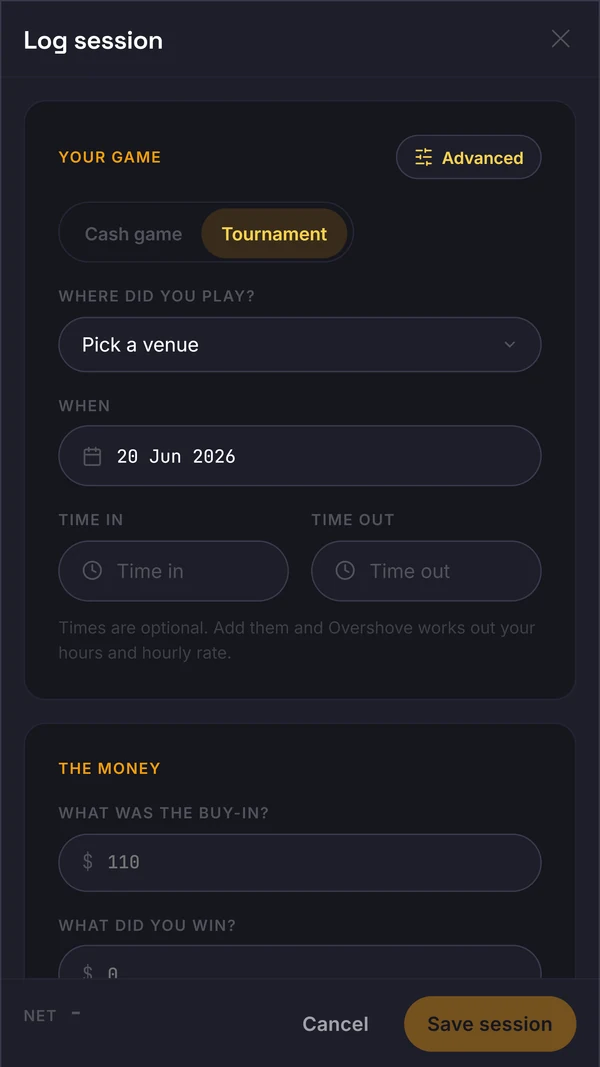
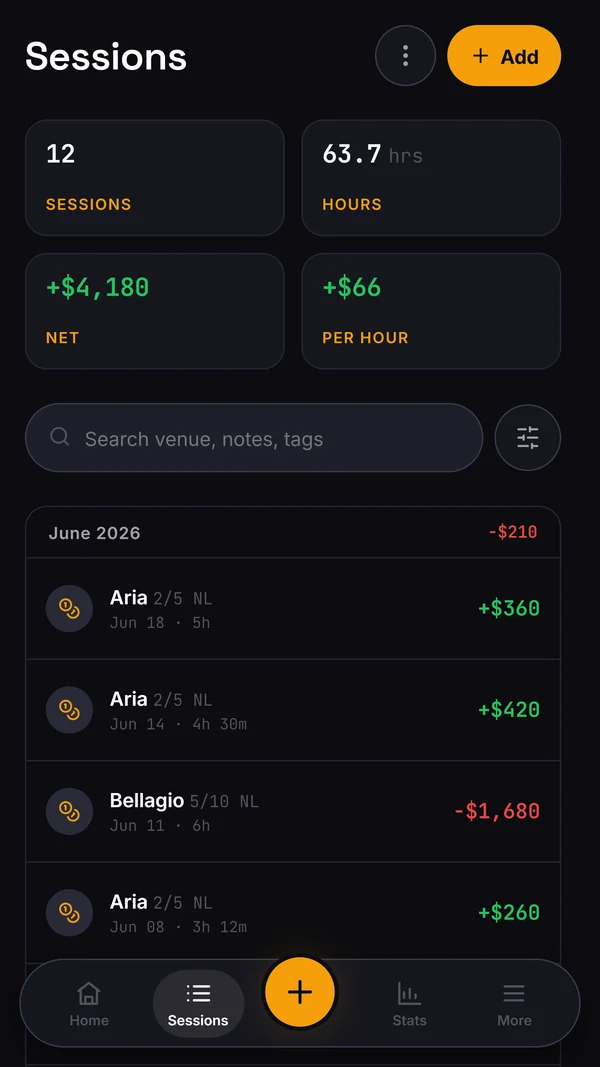
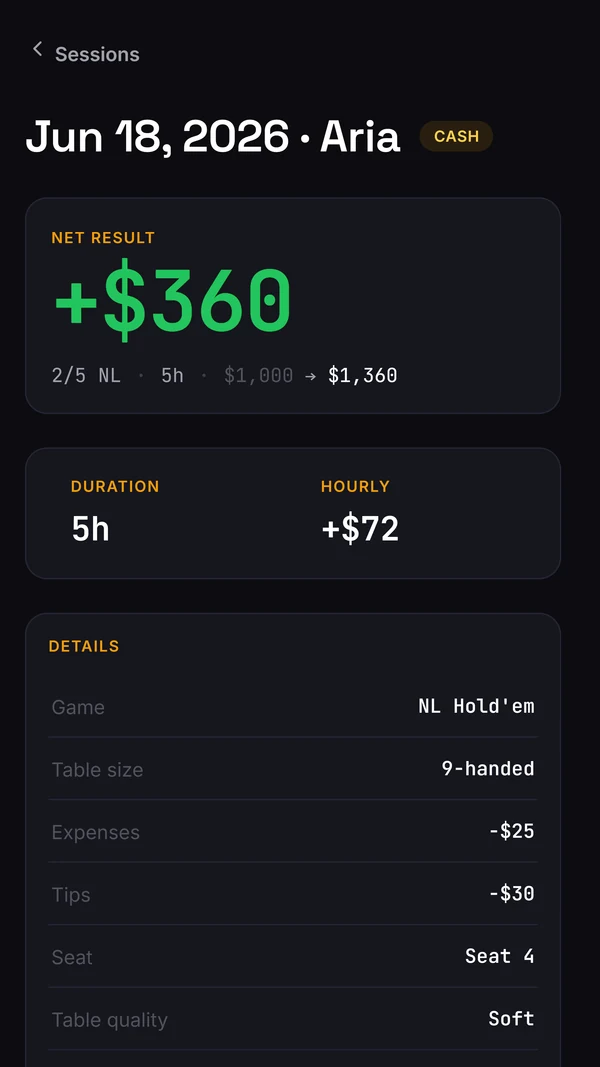
A poker session tracker should turn a night at the table into evidence you can act on, and it only manages that if the log survives contact with real play. Capture has to be quick enough to finish before you leave the room, which in practice means venue, stake, buy-in, cash-out and hours as the minimum, with the finer detail added afterwards rather than typed while the action is running.
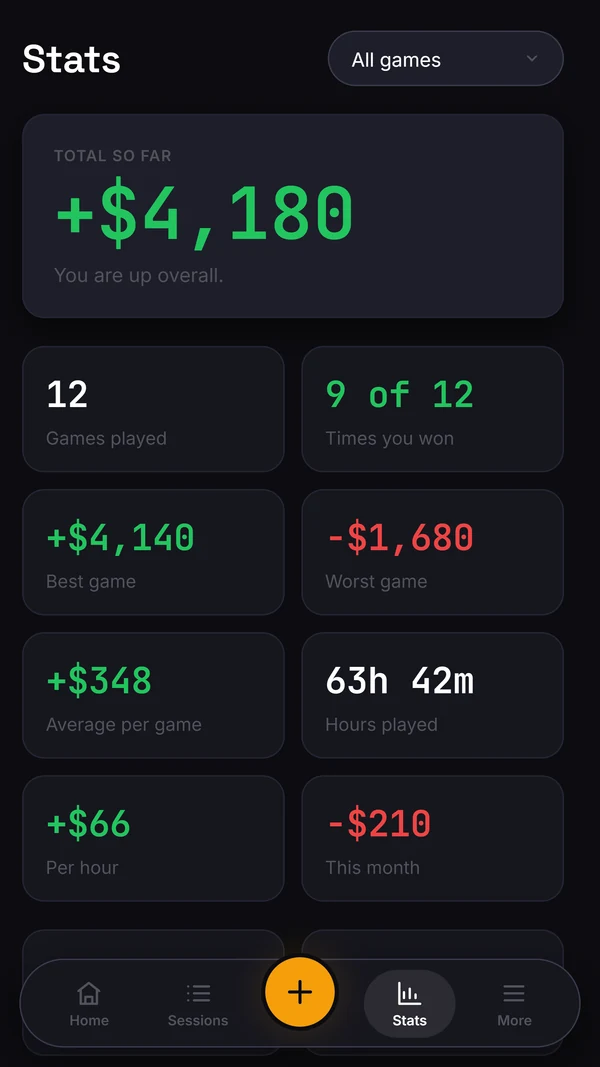
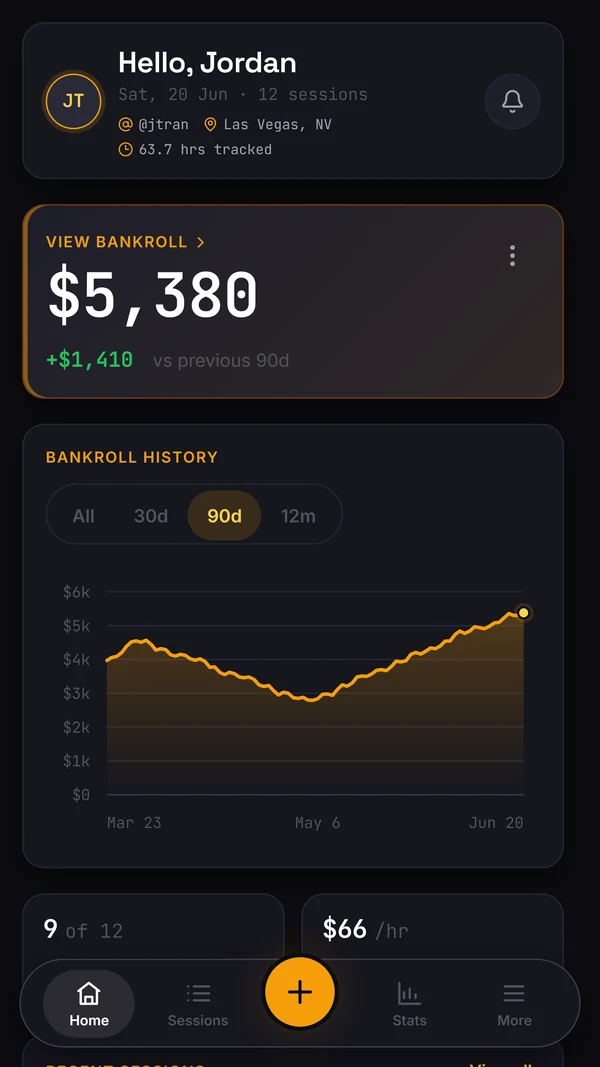
Every stat should then trace back to that log, so net by stake, the hourly after additional expenses not already included in the session result, and the bankroll curve all come from sessions you actually recorded rather than the ones you felt like recording. The tracker should also carry the session forward: a hand marked at the table, a leak tagged in review, a note on a player you will see again, and one study action before the next buy-in. Finally it should let go, exporting the full history as CSV so the sample stays yours whatever you use next.
The criteria that matter, and what most players actually track
Start with how players actually track. A spreadsheet or two-field result log is common, but it cannot separate running bad from playing bad and it is easiest to abandon during a downswing. The picture is plain: many players own a ledger, not a tracker, and the ledger goes quiet at exactly the moment the data matters most.
The criteria for a session tracker follow directly from that. First, capture speed: can you log a complete session, one-handed, at the table, in under thirty seconds? Second, traceability: do the stats on the dashboard, net by stake, BB/hr, the true hourly, trace straight back to sessions you can open and check? Third, a variance read: does the app tell you whether your win rate is signal or noise on your actual sample, or does it just print a number? Fourth, a review path: marked hands, leak tags, something that turns the log into study material. Fifth, data ownership: CSV export with no lock-in, so your sample outlives any one app.
Everything below is ranked against those five criteria, not against marketing pages. Some of the named tools beat Overshove on breadth or maturity, and this page says so where it is true.

The 2026 field, compared honestly
The table below covers the tools live players ask about most, plus the spreadsheet baseline and Overshove itself. These are genuinely different products aimed at different jobs: a staking-and-social tracker, a stats engine, a bundled study hub, a hand database, two polished iOS trackers and a free web session tracker. Calling any one of them the best without naming the job would be dishonest.
Each named row is built only from facts on that product's official site or public store listing. Where a tool is more mature than Overshove, and several are, the row says so. Fuller treatments of each match-up, including the rows where Overshove loses, live in the head-to-head comparisons on this site.
One reading note: platform availability changes fastest of all, so if a row's platform is your dealbreaker, check it again the day you decide. And treat bundled extras as weight unless you will actually use them. An unused GTO chart does not repair a gappy sample; the log itself is the part you touch every session.
How to evaluate logging speed
Logging speed is the criterion that decides whether the other four ever matter. A tracker you abandon produces a gappy sample, and the gaps are not random: missing sessions often skew losing because discipline is weakest during a downswing. Remove your worst sessions from any sample and the remaining win rate flatters you. Every stat downstream of a biased log inherits the bias, so the fanciest analytics in the group sit on sand if capture is slow.
The practical test: sit at a table, post a blind, and log yesterday's session one-handed before your first orbit ends. Five fields is the right size: stake, venue, buy-in, cash-out, hours, with tip and travel costs attached where they belong. If an app needs more taps than that for the core loop, you will skip it on the nights you least want a record, which are precisely the nights the record needs.
Then check the other half of capture: retrieval. Search and filters you will actually use, sessions by venue, by stake, by day of the week. A log you cannot interrogate is a diary, not a dataset, and the whole point of a session tracker is that the dataset answers questions the diary cannot.
The true hourly and the variance read
Cash-out minus all buy-ins is the table result. It already includes pot rake and tips or fees paid from the stack. Additional travel or separately paid costs need a further deduction only when they are outside that result. Divide by table hours for table hourly or total trip hours for overall hourly; cost breakdowns explain the result without deducting the same payment twice.
The variance read is the other number most trackers skip. Live full-ring standard deviation typically runs 80 to 120 BB/100. Take 100 BB/100 and roughly 27 hands an hour: per hour that is about 52 BB of standard deviation, around £105 at a £2 big blind. Over a 100-hour sample the standard error on your hourly is £105 divided by the square root of 100, about £10.50. So an observed £12 an hour over 100 hours carries a 95% interval of roughly minus £9 to plus £33 an hour. You cannot distinguish a solid winner from a break-even player on that sample, and no honest tool should pretend otherwise.
That is the arithmetic behind why players struggle to tell running bad from playing bad. The point number alone cannot tell them. A confidence band on the real sample can, and checking whether a tracker shows one is a five-minute test before you commit your history to it.
A worked example: what rake and tips do to a 1/2 hourly
Use a synthetic £1/£2 player over 100 table hours. Assume four won pots per hour, £4 rake removed from each and a £1 tip paid from the stack for each. The attributed deductions are £16 plus £4, or £20 per table hour. Start from an invented £32/hr before those particular deductions: cash-outs minus all buy-ins then show £12/hr, or £1,200 over 100 hours. Rake and tips are already included in that table result.
Additional fuel and parking of £10 for each five-table-hour session, paid separately, total £200 over 20 sessions. Profit after those additional costs is £1,000, or £10 per table hour. Do not subtract the £2,000 of stack-paid rake and tips again. Travel hours are not supplied here; an overall trip hourly would need that additional time in the denominator.
The £32 add-back describes the same invented outcomes before specified deductions, not a counterfactual win rate or evidence that a different room would produce the same hands and profit.
Who should pick what
Match the tool to the job you actually have. If you run staking action or want social sharing around your results, PokerBase is built for that and ships on both app stores today. If you want deep, customisable stats with your own fields, Poker Analytics is a stats engine built for exactly that job. If you want GTO preflop charts and an AI assistant bundled next to the log, PokerLog fits.
If the trainer should live inside the tracker on an iPhone, Bink bundles one. If you are all-in on iOS and want mood and health analytics alongside results, Left Pocket is the polished pick. And if your gap is a searchable database of live hands rather than a results log, Fastroll is built for exactly that, and pairs naturally with a session tracker rather than replacing one.
Overshove's current claim is narrower: it is a free web session and bankroll tracker for live cash players, with a cost-aware hourly and CSV export. The fuller variance and study workflow is in development. It makes no promise about your results. If your job needs those advanced tools today, pick a product that already has them. The head-to-head comparisons on this site walk each call in detail, including the rows where Overshove loses.
When a spreadsheet is enough
Players running a spreadsheet are not wrong, they are early. At low volume a spreadsheet is genuinely enough: a dozen sessions a month, one stake, one room, and a rough net is all you need. You own the file outright, it costs nothing, and on the data-ownership criterion nothing beats it.
It breaks down on discipline and on fields. Manual entry after a losing night is exactly when the habit is weakest, and additional expenses and statistical assumptions need explicit fields or formulas. You can construct them in a spreadsheet; judge your own logging consistency rather than assuming the format is inaccurate.
The honest switch trigger is volume plus seriousness: when you start caring whether the hourly is real, when you play more than one stake or room, or when a coach asks to see your sample. Whatever you move to, the spreadsheet history should come with you. CSV import exists precisely so the sample you have already built is never the price of switching.
Sources
Product facts checked against first-party pages and developer-supplied store listings on 5 August 2026.
- →Fast capture you will actually use
- →Stats that trace back to your log
- →Marked hands feed a study loop
- →Synced and exportable
Questions
Why does logging speed matter so much?
Because a tracker you abandon produces a biased, gappy sample, which makes every downstream stat wrong.
Live or online focus?
For live cash, prioritise fast manual capture and the true-hourly fields. Overshove is built around that.
Are the named apps in this comparison current?
Every named-tool fact on this page was checked against the product's official site or public store listing in June 2026. Apps ship changes constantly, so treat the table as a starting map and confirm the current feature set before you commit your sample to any of them.
How big a sample before my hourly means anything?
With live full-ring standard deviation around 80 to 120 BB/100, a 100-hour sample still carries a confidence interval wide enough to span break-even for most winners. Expect several hundred hours before the band narrows usefully, and prefer a tracker that shows the band rather than just the point number.
Do I need a hand database as well as a session tracker?
They are different jobs. A session tracker answers how am I really doing; a hand database like Fastroll answers what happened in that spot, hand by hand. Plenty of serious live players run both, a results log for the sample and a hand library for study.