Overshove vs legacy results trackers
Most older trackers were built to answer one question: am I up or down? They store results well. Check whether their hourly includes additional expenses paid outside the recorded session result. The free Overshove tracker records sessions and bankroll; variance interpretation and the fuller study workflow are in development.

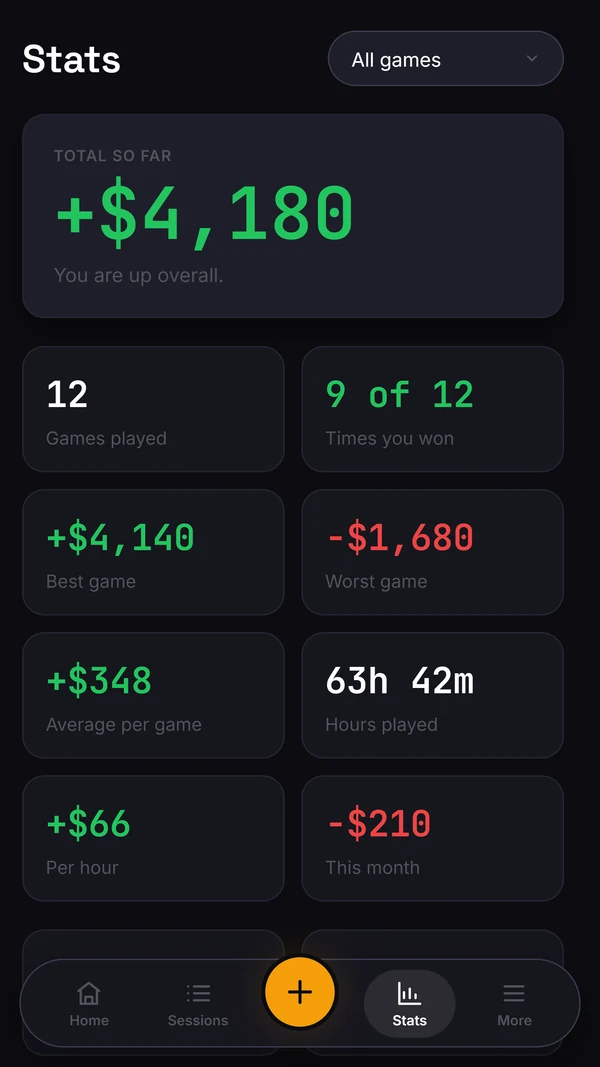
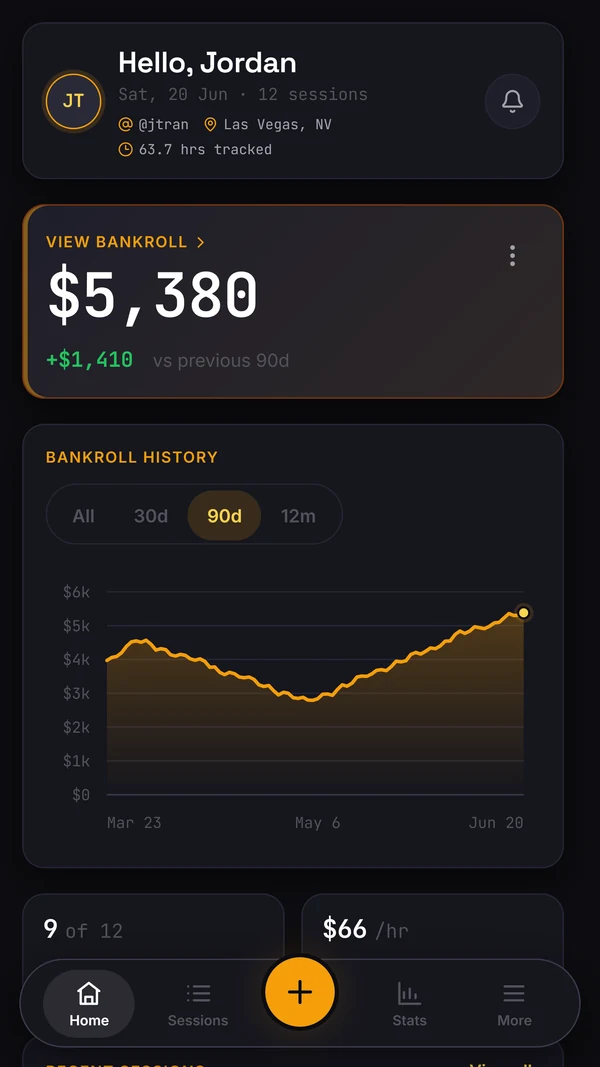
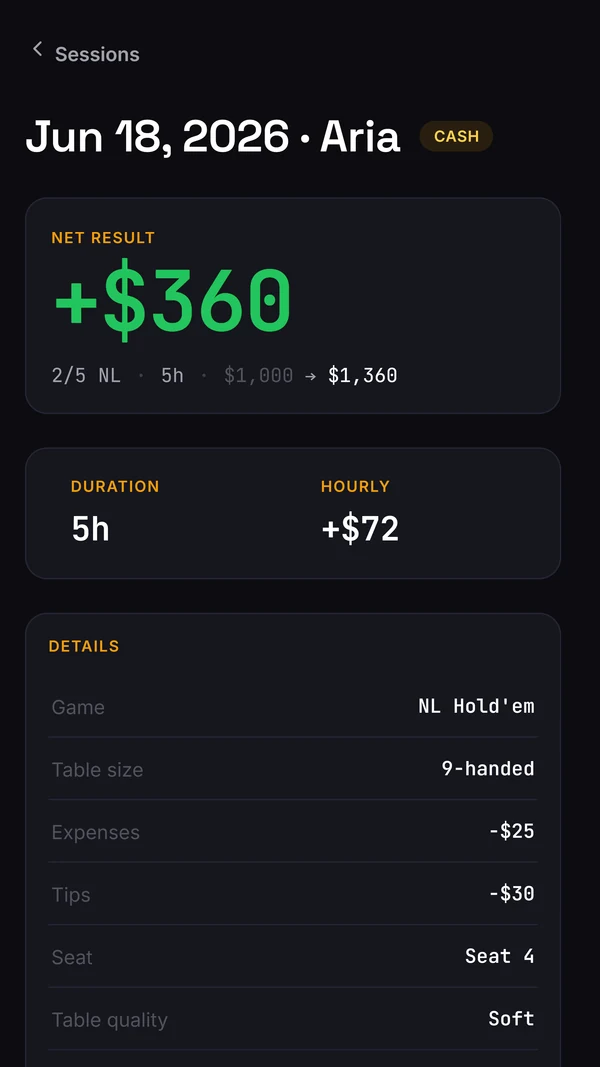
What do legacy poker results trackers leave out?
Legacy poker results trackers were built to answer one question, am I up or down, and they answer it well. What they leave out is most of what turns a result into a decision. For costs, check the actual inputs rather than the age of the product. Cash-outs minus all buy-ins already include pot rake and stack-paid tips or fees. A separate field is needed only to break those costs down or deduct additional expenses outside the result. The second is variance.
A results-only tracker draws the graph with no standard deviation, no confidence band and no read on whether six losing weeks sit inside normal noise for your sample, which is precisely the question a live player is stuck on. The third is the review loop: no leaks tagged by stake and line, no hands marked at the table for later study, no notebook of reads on a pool you see every week, and no link between a session and the work you did on it afterwards. Storage is where improvement starts, not where it happens.
What results-only tracking leaves unanswered
A two-field log is exactly what the legacy results tracker was built to hold, so the category serves a familiar habit well. Buy-in/cash-out totals include payments from the stack; a separate breakdown, additional out-of-stack costs and variance context depend on the product and records. A ledger records what happened. It cannot say whether the result was earned.
None of this means the category is broken. It means the job description is narrow. Am I up or down is bookkeeping, and old trackers do bookkeeping well. Am I beating this game, by how much, with what confidence, and where is the money leaking, is analysis. The rest of this page is about that gap: where the ledger model holds up, where it fails a live cash player who studies, and what a switch actually costs.

Where legacy trackers genuinely win
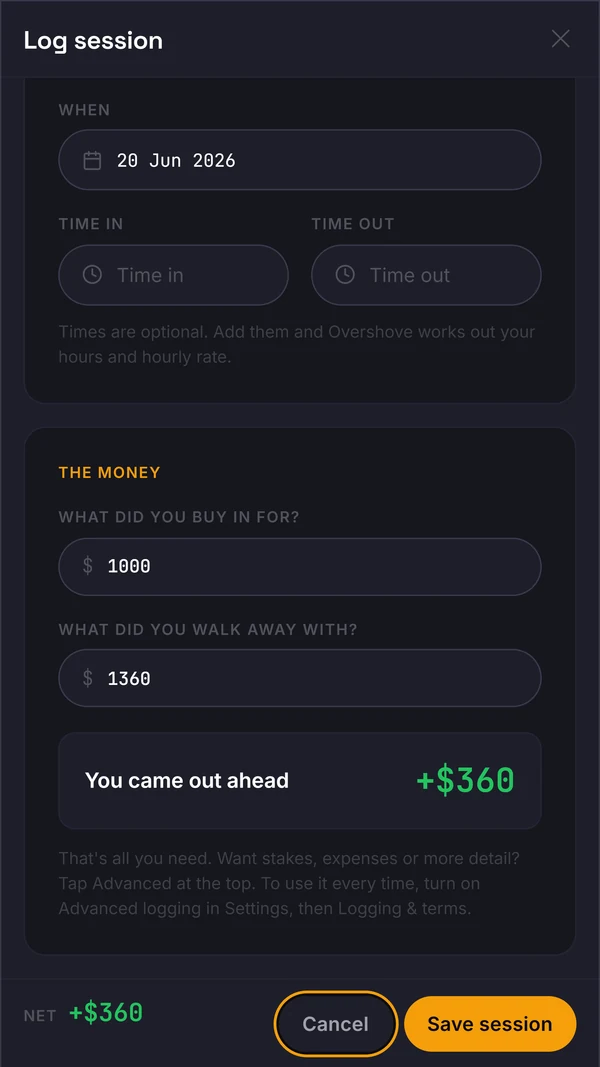
Credit where it is due. A mature results tracker is fast, stable and familiar. Entry is two fields and ten seconds, it works on the phone in your pocket at the cage, and years of releases have sanded off the bugs. Low friction is not a small thing: the single best predictor of a useful sample is an unbroken logging habit, and the simplest tool is the easiest habit to keep.
The category also holds long histories well. If you have three years of sessions in an old tracker, that continuous sample is worth more than any feature list, and a tool that never asked much of you is part of why the sample exists. Add genuine strengths like offline entry, clean bankroll graphs and low or one-off cost, and the honest summary is this: for pure results storage, legacy trackers are not beaten. They are matched, and the differences live elsewhere.
Where results-only tracking fails live cash
Start by defining the hourly. Cash-outs minus all buy-ins already include pot rake, tips and time charges paid from the stack. Deduct only separately paid travel, meals or fees not already included. Divide by table hours for a table rate, or by table plus travel time for an overall trip rate. These are different useful measures; a basic ledger is not inherently wrong.
The second failure is variance. Old trackers show a graph with no context: no standard deviation, no confidence band, no read on whether six losing weeks sit inside normal variance for your sample. That is precisely the question a results-only tracker is structurally unable to help answer. The third failure is the review loop. There is no leak tagging by stake and line, no hands marked at the table for later study, no link between a session and the work you did on it afterwards, and rarely a serious notebook for reads on a pool you see every week. Results storage is the start of improvement, not the engine.
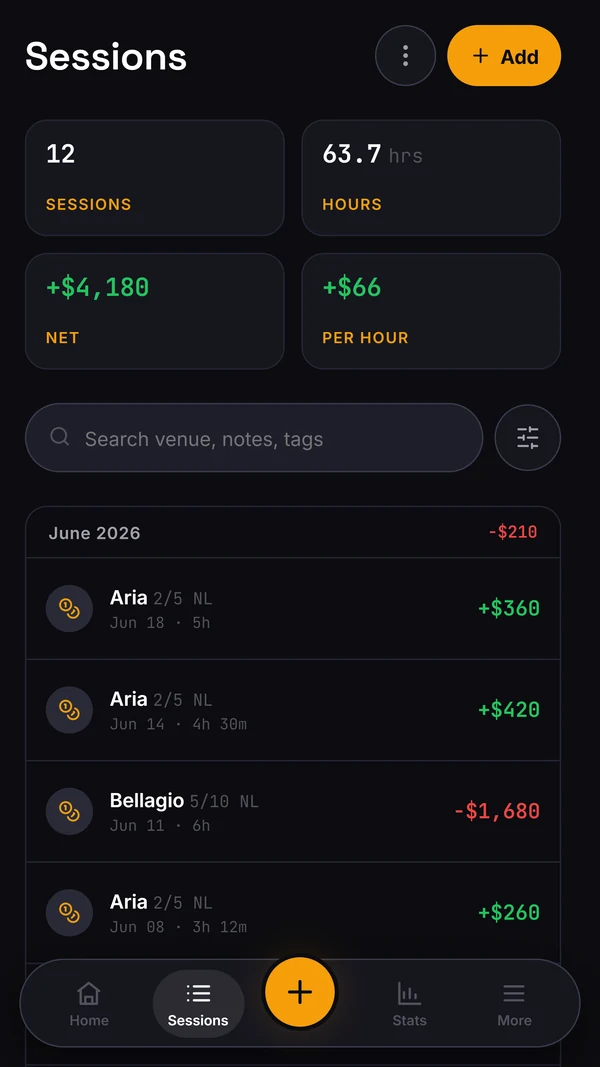
A worked example: the graph cannot answer the question
Here is the concrete version. Take a 1/2 player (£2 big blind) who has logged 300 hours and won 5 BB/hr, which is £10/hr and £3,000 total. Assume a standard deviation of 100 BB/100, ordinary for live full ring, and 28 hands per hour. Converting the SD to a per-hour figure: 100 multiplied by the square root of 28/100 gives 52.9 BB per hour. The standard error of the hourly over 300 hours is 52.9 divided by the square root of 300, which is 3.1 BB/hr.
So the 95% confidence interval on that 5 BB/hr is 5 plus or minus 1.96 standard errors, roughly -1 to +11 BB/hr. In money, somewhere between losing £2/hr and winning £22/hr. A legacy tracker shows the +£3,000 and the upward graph and implies the job is done. The interval says the sample cannot yet separate a solid winner from a break-even player. At this win rate and SD you need about 430 hours before the interval clears zero. That single calculation is the difference between a ledger and a review tool, and no results-only tracker performs it.
Migrating without losing the sample, or running both
Switching does not mean starting over. Nearly every tool in the category exports CSV; Overshove shows a session spreadsheet import control; test a small file and reconcile dates, row counts and totals before relying on a migration. Export from Overshove is also CSV at any time, so your exported CSV remains available even if you keep using the old tracker.
You do not have to switch cold either. A sensible path is to run both for two to four weeks: keep logging in the old tool, mirror the sessions in Overshove, and see whether the cost-aware hourly, bankroll view and CSV export earn their place. Some players keep the legacy tracker as a pure bankroll ledger and use Overshove for review. That is a legitimate end state, not a failure to commit. Overshove's core tracker is free, so the trial costs nothing but the duplicate entries.
Who should not switch
Do not switch if changing tools threatens the habit. Logging discipline is most vulnerable during a downswing; a tool change mid-downswing is exactly the kind of friction that kills a streak, and an unbroken log in an old tracker beats a broken log in a better one. If you are deep in a bad stretch, stabilise the habit first and migrate when things are calm.
Skip the switch too if you play a handful of sessions a month and genuinely only want the net, if tournaments are your main game (Overshove is built for live cash), or if you need a native iPhone app today, since Overshove offers an Android app and web access on iPhone and desktop. And be clear about what it is not: no HUD, no solver, no in-game edge, and no promise about your results. It is a live session and bankroll tracker, with deeper study tools in development. If that is not the job you need doing, the old tool is not holding you back.

Sources
Product facts checked against first-party pages on 5 August 2026.
- PokerTracker, first-party online tracker and analysis capabilities
- Poker Analytics, first-party live tracker capabilities
A workflow comparison against a category of tool, not a claim against any specific product. Overshove does not replace HUDs, solvers or online databases.
Will I lose my history switching?
Overshove shows a session spreadsheet import control. Keep your old export and reconcile a small test import before moving a full history.
Is it more complicated?
The core stays a fast log. The depth features are optional layers you turn on when you want them.
Can I run Overshove alongside my current tracker?
Yes. Log in both for a few weeks and compare what each tells you. When you commit, the visible session import control can be tested with a small file before any wider move.
What does Overshove cost?
The core tracker is free. After useful value, the only paid offer is Founder: one GBP 79 payment for 730 days, with no automatic renewal. It is limited to 20 places and includes a 14-day full refund. Your data exports to CSV at any time.
How much history do the variance features need?
The on-site calculator can model sample uncertainty, but the in-app variance and confidence read is in development. Early live samples are noisy, so treat the observed hourly cautiously.
Does Overshove run on a phone?
The Android app is live on Google Play. The web app works in phone browsers for logging and desktop browsers for review.